2009
#
Parselets.com : 'free, open, developer-generated APIs for a wide variety of websites. Parselets.com is a place to create and share them. [..] Check out [..] ways to use parselets from our web service, Ruby, Python, C/C++, or the *nix command-line.'
#
RegExr: Online Regular Expression Testing Tool : a very nice interactive editor in Flash, supporting lots of the usual perlish stuff. via Joe
via:jdrumgoole regexps regular-expressions spamassassin rule-dev flash regex flex utilities
#
For the past 2 years or so, I've been using GMail to handle my main mail feed for jmason.org. I'm an absolute convert to its "river of threads"/search-based workflow.
Since starting at Amazon, I've had to start dealing with a heavy volume of work mail. Previously jobs have either had low mail volumes, or used Google Apps hosting for their mail, but Amazon's volumes are high and -- obviously -- they're not using Google. ;) For a while, I tried using Thunderbird, but it just didn't really cut it; I could never keep track of mails I wanted archived, or remember which folder they were in, etc. -- the same old problems that GMail solved.
Enter Sup. It's a console-based *nix email client, with a Mutt-like curses interface, which offers something closely approximating the GMail experience:

Sup is a console-based email client for people with a lot of email. It supports tagging, very fast full-text search, automatic contact-list management, custom code insertion via a hook system, and more. If you're the type of person who treats email as an extension of your long-term memory, Sup is for you.
Inbox Zero is a daily occurrence for my work email now; I can simply archive pretty much everything, and reliably know the excellent full-text search support will allow me to find it again in an instant when I need it. The new-user guide is well worth a read to get an idea of its featureset and UI.
Setting it up
The process of getting it set up is quite hairy; here are some instructions for Ubuntu, which thoroughly failed to work for me on 9.04. I had a similarly tricky time using some Ruby packages on the Red Hat work desktop, but eventually avoided it by just building vanilla Ruby from source, then using that to install "gem" and from that, "sudo gem install sup". Much easier...
Next step is to get the mail. From some reading, it appears the most reliable way to deal with a MS Exchange 2007 server is to use offlineimap to sync it to a local set of maildirs, then add those as Sup "sources" using sup-add, one by one. This is very well supported in Sup, and works well. Offlineimap is very easy to install on Ubuntu, and can easily be built from source if that's not an option. My config is pretty much a vanilla copy of the minimal config.
There's a good Sup hook to run "offlineimap" every poll interval, and rescan synced sources that contain new mail. It works well.
Sup has an interesting approach to mail storage -- it doesn't. Instead, it stores pointers to the messages' locations in their source storage. This is a great idea, since bugs in Sup therefore cannot lose your mail -- just your metadata about your mail. However, it means that if the source changes in a way which moves or removes messages, you need to tell Sup to rescan (using "sup-sync"), but that's no big deal in practice; in the more usual case, if new mail arrives, it's automatically rescanned.
I have just under 7000 mail messages in my Sup index, and rescans are speedy and searches super-fast. It's very nicely done.
Outbound mail is delivered using /usr/sbin/sendmail by default, which should be working on any decent *nix desktop anyway ;)
Recommended Hooks
The Hooks wiki page has a few good hooks that you should install:
- ~/.sup/hooks/before-poll.rb: the above-mentioned offlineimap poll hook
- ~/.sup/hooks/mime-decode.rb: 'uses w3m to translate all HTML attachments that don't have a text/html alternative.' Well worth installing.
- ~/.sup/hooks/before-add-message.rb: essential to filter out cron noise and the like so it doesn't hit the inbox; unfortunately Sup doesn't (yet) support GMail's "filter messages like this" UI.
Bad Points
-
Long URIs: unfortunately, very long URIs are broken by Sup's renderer, and it doesn't offer a native way to "activate" URIs and have them displayed in the browser; instead one has to cut and paste them. This is pretty lame. I've hacked up a perl script that will reconstruct the full URLs from the broken rendering, when the text is piped to it, but that's a horrible hack.
-
Index Corruption: I've had the misfortune (once, in the month since I started) of corrupting my search index, causing Ruby exception stack traces when I attempted to run "sup-sync" to scan new mail. The only fix appeared to be to restore my index from a "sup-dump" backup. Thankfully all seems fine now, but it was a definite reminder of the product's beta status.
-
Calendaring: still as painful as it's ever been with UNIX command line email.
-
HTML: A good-quality, email-oriented, native HTML renderer would be awesome.
-
MIME: Sup again takes the traditional approach from UNIX command line clients of delegating to the mailcap file and its rules; unfortunately my RHEL5 desktop is too crappy to have a good mailcap setup. So I've had to write this from scratch to deal with the usual .docs and .xls's etc., flying about.
-
Inconsistent Key Mapping: Given that it shares so much UI with GMail in other respects, it's a little annoying that Sup doesn't have the same key mapping. Not a big deal, as it took only a couple of hours to get the hang of Sup's, though.
Overall
If you're happy enough to spend a day or two getting the damn thing installed, and aren't afraid of a little dalliance with the bleeding edge, I strongly recommend it. It's definitely the best *NIX mail reader at the moment.
#
Deployment is just a part of dev/ops cooperation, not the whole thing : metrics, monitoring, instrumentation, fault tolerance, load mitigation called out as other factors by Allspaw
ops deployment operations engineering metrics devops monitoring fault-tolerance load
Build Web Apps for iPhone using Dashcode : hmm, not too tricky
#
Fill and span DVD archives with Discspan : filed under "about time I did another DVD backup"
backup dvd spanning via:donncha linux storage offline recovery
#
mnot's Weblog: HTTP + Politics = ? : how the Great Firewall of Oz breaks so much more than the web browser
Play framework : 'a Java framework made by Web developers. Discover a clean alternative to bloated enterprise Java stacks. Play focuses on developer productivity and targets RESTful architectures.'
Turing-incomplete Lua? : discussion thread on the cons of using Turing-complete general-purpose programming languages in places where it's not necessary, such as configuration files
#
Why it's time to lighten up about "weird" Japan : 'Being majime (too serious) is not cool in Japan; likewise it is important for voyeurs of Japanese culture to recognize that most everything pop-culture-y that is exported to the West comes at us with a wink. If you're all up in arms about it, then maybe the joke is on you.'
#
GameFAQs: Assassin's Creed II (X360) Puzzle/Codex FAQ : linked by Nelson; will return to this once i've gotten into the game
#
How to build a Google Chrome extension in 15 minutes : wow. that _is_ easy; wonder if it'd be nearly as easy to write an extension as it is nowadays to write userscripts in Firefox
user-scripts google chrome firefox extensions coding html css
Useful Google Chrome Extensions : from Nelson. looks like it's becoming a viable browser, maybe I'll give it a go
The Beer with the Green Label : Sierra Nevada tries to reclaim its cred - CHOW : 'Ask a craft brewer which other brewers he most admires, and he's likely to mention Sierra Nevada. The Chico, California, brewery is considered to be sacred ground, and its beers expertly crafted. "When you die as a brewer, you go to Chico," says Matthew Brynildson, brewmaster of Firestone Walker in Southern California.' paging Ben
#
Code: Flickr Developer Blog » Flipping Out : Flickr don't use branches. mental
branching integration branch version-control coding flickr sysadmin wtf deployment
#
best Comic Sans story ever : MeFi commenter ftw
#
How Google/Firefox Geolocation API works : I didn't realise Firefox's geolocation used wifi triangulation, too
Highcharts: JavaScript Charts that don't suck : good HN thread on better charting tools in JS
#
Charlie's Diary: The myth of the starship : Charlie Stross' thoughts on the true viability of interstellar travel. This was about the most thought-provoking bit of 'Accelerando' for me alright
#
Church 'lied without lying' - The Irish Times - Thu, Nov 26, 2009 : you have got to be kidding. Father Ted meets the Inquisition
#
Meeting Notes 2009 11 24 - Noisebridge : notes curated by Danny O'Brien: 'I have volunteered to take the meetynge notes in the style of a 17th century essayist.'
All Android Phones : so many! Saw a Hero last night, it looked pretty swish -- although not quite as pretty as the iPhone ;)
explicitly running author tests from a CPAN module : we do something similar in SA
#
"Source Code Optimisation", Felix von Leitner, Linux Kongress 2009 [PDF] : Good presentation on C compiler optimization, via Cal Henderson. 'People often write less readable code because they think it will produce faster code. Unfortunately, in most cases, the code will not be faster.' I particularly like 'Fancy-Schmancy Algorithms': 'If you have 10-100 elements, use a list, not a red-black tree; Fancy data structures help on paper, but rarely in reality. (More space overhead in the data structure, less L2 cache left for actual data.)'
via:iamcal compilers c c++ optimization coding assembly speed for:colmmacc
Me and Belle de Jour – 'Could it be Brooke?' : LinkMachineGo knew the true identity of Belle du Jour way back when -- and set a Google trap to ensnare snooping journos. nice work
belle-du-jour google blogging blogs via:waxy privacy googlewhack identity daily-mail journalism
#
JSON Format : 'your online JSON Formatter'. useful. via JKeyes
Summary of all the MIT Introduction to Algorithms lectures : good reviews and notes from Peteris Krumins
#
MacRumors iPhone Blog: Undercover 1.5 Adds Push Notification Tool to iPhone Theft Recovery App : very clever. 'You can make the messages as enticing as you want - say, by having them pretend to be a notification from your bank account. If the crook chooses to view the push notification, Undercover will launch, [..] loading any Website of your choosing, such as the aforementioned bank's. While the thief is distracted, Undercover will be happy to save the device's GPS coordinates and IP address to Orbicule's Website.'
Boingo Wireless - AVOID : argh. wish I'd seen this page before I signed up for a month's access while travelling -- they've now charged my credit card again, over a week after I requested the account's cancellation :(
boingo avoid customer-service customer-hostile scams wifi travel
#
HTC Hero is on Meteor : according to Fergal, at half of the price of O2's iPhone "deal"
SSL trick certificate published : ioerror published the '\00' wild-card SSL cert for any domain (for affected SSL client libs at least)
#
Irish iPhone users -- you may find this useful. I've written a web scraper which takes a couple of the more useful pages on Met Eireann's website -- the regional forecast and the rainfall radar page -- and reformats them in an iPhone-optimised style. Enjoy:
- iPhone-Optimised Weather Forecast for Ulster
- iPhone-Optimised Weather Forecast for Munster
- iPhone-Optimised Weather Forecast for Leinster
- iPhone-Optimised Weather Forecast for Connacht
- iPhone-Optimised Weather Forecast for Dublin
(updated: supports all the provincial forecasts now)
#
Google employees now discouraged from using Python for new projects : 'You have to balance Python's strengths with its weaknesses: your engineers may be more productive using Python, but if they have to work around more platform-level performance/scaling limitations as volume increases, do you come out ahead? etc.'
google performance scalability python unladen-swallow languages via:preddit
#
Damn Cool Algorithms: Spatial indexing : quadtrees, Hilbert curves, and geohashing, as seen in Google's new Closure library. useful for multidimensional addressing in general
algorithms mapping gis indexing quadtree datastructures spatial geometry
#
Mint Studio Multi-Room Wireless Speaker : $130 speakers; outputs from computer via USB, transmits to wireless receiver, which also has an iPod dock and a line-in. exactly what I'm after! (thanks Jason for the tip)
IT Law in Ireland: Irish law on hacking tools / dual-use software : specifically, a port of dessid to the iPhone, recently causing headlines
dessid eircom hacking dual-use software distribution law ireland tools security
#
SBSettings : good overview of this jailbreak app
Why would I want to jailbreak an iPhone 3GS? : Ask MeFi thread, mostly recommending tethering and SBSettings
Subversion Submitted to Become a Project at The Apache Software Foundation : woot!
#
Spiritual search turns into a stampede as impatient lose faith in double visionaries - The Irish Times - Mon, Nov 02, 2009 : hilarious article on the BVM-witnessing hysterics in Knock. 'if you looked hard enough, you could indeed discern a face in the play of light and shadows. When I squinted a certain way, I thought I could make out Bruce Forsyth.'
Structural Regular Expressions : 'The current UNIX text processing tools are weakened by the built-in concept of a line. There is a simple notation that can describe the `shape' of files when the typical array-of-lines picture is inadequate. That notation is regular expressions. Using regular expressions to describe the structure in addition to the contents of files has interesting applications, and yields elegant methods for dealing with some problems the current tools handle clumsily. When operations using these expressions are composed, the result is reminiscent of shell pipelines.' Paper by Rob Pike, via adulau. intriguing
sregex via:adulau regexp rob-pike regex library text structural parsing
sregex - Structural Regular Expressions : 'The sregex module implements Structural Regular Expressions.' Python, Apache-licensed
sregex python via:adulau regexp robpike regex library text structural parsing
The Rise and Fall of the Hobbyist Game Programmer : great article on the 80's one-man shareware game hobbyists (via Walter)
1980s games history programming nostalgia geek gaming hobbies coding 6502 c=64
#
Mike Shroepfer on Engineering at Scale at Facebook : lots of gory details on FB's innards via Dare Obasanjo
facebook scaling scalability erlang caching architecture multifeed
Build a Silent, Standalone XBMC Media Center On the Cheap : sweet. HDMI out, MythTV streaming, and silent for $300
mythtv hdmi tv diy linux media-center nettop htpc xbmc hardware
MullingarHeifer.com : 'Become a virtual beef farmer. Control your personal food chain.' also deliver prime beef. mmmm
meat beef mullingar heifers cows food eating shopping ireland
#
MAAWG notes drop in spam levels : 'MAAWG [..] says that spam and malicious emails dropped to 89 percent in the second quarter from 90.4 percent in the first quarter of 2009.'
#
Common Errors Causing DKIM Verification Failures : informative, from Cisco (via BoxOfMeat)
IAMA person who sends "spam" email for a living : Reddit mass-interview of a spammer. apparently he's working on IPv6 support
#
Time Warner Cable Exposes 65,000 Customer Routers to Remote Hacks : massive fail. 'By simply disabling Javascript in his browser, he was able to [...] dump the router's configuration file [...which] included the administrative login and password in cleartext.'
smc8014 doh privacy internet security fail time-warner via:reddit pathetic javascript
Cybercrime Organizations Turn to 'Mafia-Style' Structure : good research coming out of McAfee -- lots of Eastern European, Russian, and ex-USSR-country cybercrime businesses nowadays, apparently
spam scams scareware russia eastern-europe ukraine romania credit-cards antivirus mcafee security phishing
XZ Utils : 15% smaller than bzip, 30% smaller than gzip, and now shipped with Fedora and Ubuntu. uses LZMA2
#
Why I like Redis : Simon Willison plugs Redis as a good datastore for quick-hack scripts with requirements for lots of fast, local data storage -- the kind of thing I'd often use a DB_File for
python storage databases schemaless nosql redis simon-willison data-store
Unicorn at GitHub : new Ruby HTTP server, using a preforked process pool based on select(). Github like it because of failure-recovery problems with Ruby threading bugs in Mongrel. The preforking algo used is extremely rudimentary -- the kind of thing we used in SpamAssassin before I implemented Apache-style preforking in 3.0
web ruby rails github nginx httpd server mongrel unicorn rubyonrails preforking unix fork select process-pool
Introducing BERT and BERT-RPC : another serialization format, binary, no IDL, no code generation, from GitHub
github bert erlang ruby rpc protocol thrift serialization networking
#
Jailbreaking the 3GS iPhone with PwnageTool and OS 3.1.2 : a good guide
Red Faction Guerilla Tales: Fully Destructible Integrity : Tom Francis gives "Red Faction: Guerilla" a truly massive plug based on its pervasive freeform environment destructability. I'm sold!
gaming games xbox360 red-faction red-faction-guerilla to-get want tom-francis
pigz : 'A parallel implementation of gzip for modern multi-processor, multi-core machines', by Mark Adler, no less
adler pigz gzip compression performance concurrency shell parallel multicore zip software
#
Charlie Brooker interview re Gameswipe : to read, yoz gives it the thumbs up
uk games gaming via:yoz interviews charlie-brooker tv gameswipe
#
Track down your stolen laptop – Prey : hmm, a nifty app that takes pics of the desktop, activates the webcam etc. and uploads to a central server if you activate a 'my laptop has been stolen' bit
prey theft laptop osx linux windows tracking recovery crime lojack
DDOS mystery involving Linux and mod_ssl : connections to brutus.apache.org, "GET / HTTP/1.1", massive HTTPS DDOS. no idea what's going on
#
O2 Ireland blocking sites listed in the UK IWF list : supposedly should only list child porn sites, but sounds like it's got frequent false positives on file upload/download services nowadays
YouTube - "charlie brooker's gameswipe" ibbstersthecrapgamer : all 6 parts of the first episode, via Waxy. will watch this at some future point when I have free time again!
#
Regarding Google Wave's similarity to Lotus Notes, which is a meme I've heard from several angles -- David Jones hits the nail on the head:
Well, I used Notes from 1994 to 1999. It did have a database backend for e-mail and a rich collaborative editing model. But it didn't have realtime shared editing, or instant annotation.
And it was shit. No-one in their right minds would have wanted the future of the web to have been Notes. Even though, and I completely agree, it did things that the web is now only just getting round to.
+1 to that!
#
The Duct Tape Programmer - Joel on Software : 'He is the guy you want on your team building go-carts, because he has two favorite tools: duct tape and WD-40. And he will wield them elegantly even as your go-cart is careening down the hill at a mile a minute. This will happen while other programmers are still at the starting line arguing over whether to use titanium or some kind of space-age composite material that Boeing is using in the 787 Dreamliner.'
duct-tape jwz funny joel-spolsky hacking coding overengineering architecture-astronauts
#
Ag Tweet: Paying Customers : pay EUR3 per month to receive Twitter @replies to your SMS mobile in Ireland -- a good niche
Dubs On Wheels : 'Where can I find an available DublinBike?' -- another DublinBikes mashup. hopefully JC Decaux won't C&D this one
mashups useful web dublin dublinbikes jc-decaux bikes cycling commute
details of the Markdown Javascript-escaping hole : as used to exploit Reddit and create a comment worm
#
Excellent animated treemap dataviz : "How the Giants of Finance Shrank, Then Grew, Under The Financial Crisis". but the data is less interesting than the excellent dataviz technique used to display it
data dataviz visualization economy animation nyt infographic infographics treemap design flash banking nytimes bailout
#
Nelson Minar plugs a new way to write web apps : Every HTML page is static -- the dynamic parts are entirely DOM-injected from server-delivered JSON by client-side Javascript. No dynamic data is delivered in HTML. I'm thinking about this, and it does seem to bring a lot of positives. hmm
#
Please don't hesitate to contact me - a rant about Powwow Water : brilliant encounter between an inept UK water-cooler supplier, the cluetrain, and the Streisand effect
funny law streisand-effect legal-threats prfail pr powwow water uk water-coolers blogging ethics fail
#
The technology behind Tornado, FriendFeed's web server : more on the new async HTTP server from FriendFeed/Facebook, in Python. looks lovely
async http epoll python comet long-poll facebook scaling scalability web friendfeed tornado opensource
Tornado Web Server : 'an open source version of the scalable, non-blocking web server and tools that power FriendFeed. The FriendFeed application is written using a web framework that looks a bit like web.py or Google's webapp, but with additional tools and optimizations to take advantage of the underlying non-blocking (epoll) infrastructure.'
epoll open-source python http scalability facebook scaling web
Embeddable Google Document Viewer : 'Google Docs offers an undocumented feature that lets you embed PDF files and PowerPoint presentations in a web page. The files don't have to be uploaded to Google Docs, but they need to be available online.' sweet!
google google-docs javascript iframe content pdf adobe html web documentation embedding powerpoint ppt viewer embed embedded
Chris de Burgh sees red - The Irish Times - Fri, Sep 11, 2009 : awesome vitriol from the big-in-the-80's Irish balladeer
Treatment of Alan Turing was "appalling" - UK Prime Minister : woot, nice work jgc!
jgc apologies uk england justice government computing history wwii codebreaking science turing gay rights apology alan-turing
TechCrunch falls for Facebook fakie : FB add a (working!) "Fax This Photo" feature, only visible to TechCrunch IP ranges -- and TC fall for it, pushing an unverified story to live, after waiting only 24 minutes for a verification. nice one FB
facebook fax dead-media funny pranks punkd techcrunch pr humor
#
Creative Ireland take on Coir's "No To Lisbon" posters : photoshop phun galore. "Foreign Toilets: VOTE NO" (via Shane Hegarty)
Irish alternative to poor FedEx : Brendan plugs Wells Cargo, good international couriers if you're sending from .ie
#
100 Examples of Japanese Municipal Flags : a lot more awesome than the title would suggest (via TTT)
Postfix - (almost) a satellite system : how to keep a small number of user accounts (ie. root) delivering locally while the rest are delivered to a smarthost
#
Colm's "n+1" post reminded me that I'd forgotten to write about this.
On July 27th, I started at Amazon, in a new Dublin-based software dev team working on infrastructure automation. It's now (just over) a month later, and I'm enjoying it immensely.
Needless to say, this company does some very interesting web-scale technology, and getting to look inside the AWS sausage factory is really enjoyable, believe it or not ;)
(I should also post a pic of my glorious screen real-estate. The hardware is a massive improvement over the previous gig, thankfully.)
Unfortunately, however, this has coincided with a lack of free time to blog and keep up with interweb-based leisure pursuits, including SpamAssassin. Really though, this is more due to looking after two wonderful little girls under 2 years of age, rather than the job -- but still, I need to remedy my neglect of this site...
In SpamAssassin news: we've been putting out some alpha releases of 3.3.0, and are planning to do a mass-check for score-generation in the next couple of days. Hopefully we can drive 3.3.0 to a GA release in a few weeks.
Also -- we're still looking for more people in the Amazon team, and hiring aggressively. If you're looking for an interesting software dev role in Dublin, get in touch!
PS: it was Bea's second birthday last weekend. Check out the awesome Very Hungry Caterpillar cupcake cake made by the missus for the occasion:

#
Ben Collins-Sussman: The True Path : Ben C-S rejigs the legendary "ed, man! !man ed" net.humor for a new age of DVCSes
TCD researchers first to find genes unique to humans : go Aoife! "This is the first ever discovery of novel human-specific protein coding genes," said Dr McLysaght. "They are found in humans and nowhere else."
science genetics research biology evolution tcd sfi genome junk-dna
#
Hudson Nabaztag Plugin : get a glowing rabbit to semaphore latest C-I build status
CloudSplit – Real Time Cloud Analytics : interesting idea from Joe -- track your cloud-hosting spend in real-time
cloudsplit hosting amazon ec2 azure joe-drumgoole analytics real-time
Why WeakHashMap Sucks : 'SoftReferences are the cheap, crappy caching mechanism [...] perfect for when you'd like your cache to be cleared at random times and in random order.'
softreferences weakreferences weak references gc java jvm caching hash memory collections vm weakhashmap via:spyced
Cóir Launches No To Lisbon Campaign : Satire site The Emergency on pro-life paramilitary nutter group Coir's new scaremongering campaign: "A German Will Be In Charge Of The SKY Remote IN YOUR LIVING ROOM!!!! Unless you vote NO!" -- a pretty accurate rendition of their posters
coir politics ireland satire funny the-emergency youth-defence
#
Playhouse running on Liberty Hall last night : wow, looks absolutely excellent! nice work (via Mulley)
playhouse cool art installations blinkenlights liberty-hall dublin
#
Pinboard can now mirror a delicious account : yay! Let's see if this shows up at http://pinboard.in/u:jm ;)
SD, a distributed bug tracker : now available. sadly, no support for Bugzilla, which is what we use in SpamAssassin (srsly), so I won't be trying it out just yet, but still -- cool
bugs bug-tracking trac prophet distributed coding tools web sd
Simpleton's guide to git : it really is. Yet another one-page intro to git, but a good one
#
Pirate Bay latest: big music labels to issue injunction against Chorus NTL : UPC: "bring it on", essentially
#
In Which She's Every Woman : what it's like to have your photo used for stock images
stock-photos yvonne-georgina-puig photos pictures licensing ads
Hacking a Google Interview : course notes from a 4-day MIT course on tech interviewing (via Hacker News)
interviews google hiring puzzles mit questions coding computer-science algorithms
Hijack: Get A Live IRB Prompt For Any Existing Ruby Process : injects via gdb. pretty cool, if it works; one comment notes that they couldn't use it on a Rails app
#
8-bit trip : flipping amazing stop-motion LEGO animation paying homage to classic C=64 and NES gaming, featuring International Karate, Pong, Tetris, Super Mario Bros, and Pac-Man from swedish duo Rymdreglage (via Conor)
wow 8-bit animation stop-motion video youtube rymdreglage c=64 nes international-karate pac-man pong tetris mario-rosenstock
#
10 best Irish Camping Sites : including one place that includes an open farm. result
codepad.org : 'an online compiler/interpreter, and a simple collaboration tool. It's a pastebin that executes code for you. You paste your code, and codepad runs it and gives you a short URL you can use to share it.' supports C, C++, D, Haskell, Lua, OCaml, PHP, Perl, Python, Ruby, Scheme, and Tcl code; isolated by a geordi-based supervisor, in turn running inside a firewalled virt, in turn running inside a firewalled dom0. nice work!
codepad vm jails infrastructure security via:waxy c languages programming sandbox pastebin
#
Hourly forecast for Dublin (Ireland) – yr.no : another weather forecasting service which may be more reliable than Met Eireann, this time from yr.no, the joint online weather service from the Norwegian Meteorological Institute and the Norwegian Broadcasting Corporation. if only Met Eireann spent our taxes on something of this quality (via Stephen Mulcahy)
via:smulcahy norway met-eireann ireland weather rain dublin yr.no taxes
#
Thunderbird "open in external editor" add-on : Seems to work nicely. Not quite as cleanly integrated as It's All Text! for Firefox, but getting there
thunderbird editing vim emacs gvim its-all-text mail text extensions add-ons plugins
#
Socializing the Weather : so Met Eireann's crappy weather forecasts are actually just what they give out "for free"; if you pay extra, they have more accurate forecasts. what a scam for a govt department! Handily though, they are mandated by law to give out decent forecasts to pilots -- which are available online
eidw taf terminal-area-forecasts aviation flying pilots met-eireann weather forecasts government
#
bank-trojan fraudsters use Twitter to control botnet : next in a long line of one-to-many communication systems used by bad guys
Dublin Bikes : the new rental-bike system for Dublin from JC Decaux and Dublin City Council. woeful coverage, and eye-wateringly expensive; don't keep a bike out overnight or it'll cost you EUR30!!
#
iPhone Sudoku Grab: How does it all work? : lovely run-through of the computer-vision algorithms this iPhone app uses (via Waxy)
via:waxy ai image programming algorithms graphics iphone ocr computervision opencv sudoku
The Irish Economy blog : features mainly posts from NAMA-sceptic economist Karl Whelan
UCD Economist Karl Whelan pours cold water on the Irish Government's NAMA plans : 'What we now know is that the banks have been actively working to keep development properties off the market, so that their true values are kept out of the public domain. However, to work through our current problems, these property assets are going to have to be dealt with – either sold at a reasonable price or else demolished or returned to agricultural usage.' oh dear
nama ireland economy banking property liam-carroll zoe accbank karl-whelan
Irish College of General Practitioners' advice on H1N1 : promises to be frequently updated if/when anything might happen. certainly better advice for Irish sufferers than the useless PR spooge put out by the HSE -- as usual
#
Stephen Hawking Has Not Yet Been Murdered by the NHS : hilarious response to mind-boggling US healthcare talking-point derpitude: 'People such as scientist Stephen Hawking wouldn't have a chance in the U.K., where the National Health Service would say the life of this brilliant man, because of his physical handicaps, is essentially worthless.' fantastic
politics humour healthcare via:bwalsh stephen-hawking us-politics derp morons funny nhs uk
#
Next Generation Java Programming Style : a Reddit-friendly 8-point list of new idioms for Java code in a more functional style. not sure about a couple of these, but another couple get my +1
erlang via:janl coding java oop style fluent-interfaces final encapsulation
Gadget-supported Gmail (ad-less & wide) : nice GMail userscript to remove the ads
#
BBC News on Colin Powell dancing to Yahoozee : The Beeb definitely takes it too far with this one; the song isn't clearly about 419 at all
Some Say Hip-Hop Song 'Yahoozee' Is About Nigeria's Cyberscam Industry : the Washington Post on the Yahoozee thing
background on Yahoozee : bit of controversy about Colin Powell dancing (!) to a song that promotes the "Yahoo boys", 419 scammers -- but it doesn't sound like that's the case, going by this post
#
Anti Spear-phishing SpamAssassin ruleset : from Julian "MailScanner" Field (via the SA users list)
spamassassin anti-spam rulesets sa-update phishing blocklists
#
Internet access is Britons' top priority : 'Britons will choose to cut back on almost anything other than food before economising on electronic communications services. Crucially, we will even cut spending on their mobile phone and TV package before foregoing Internet access'
internet broadband uk ofcom research recession cutbacks spending consumer mobile tv linx
Blinkenlights comes to Liberty Hall : 'We will turn Dublin's tallest building into a giant public canvas—and we want you to play with it. Our simple tools allow you to animate your thoughts and broadcast them on the city skyline.' open from Aug 24 until Sep 24
dublin ireland playhouse blinkenlights art via:pbenson architecture
#
Premature Flexibilization Is The Root of Whatever Evil Is Left : great blog post on the YAGNI principle. +1
#
Boards.ie thread about iPhone 3GS shortages : YA set of "I got mine after queueing from 7.30am" posts. wtf Apple, this is a shambles
apple stock-control shipping ireland o2 boards just-in-time delivery retail not-very-good-at-this
A short history of btrfs [LWN.net] : wow, sounds good! looking forward to this hitting production-ready status
btrfs history zfs linux open-source licensing storage sysadmin b-trees b+trees algorithms fs filesystems
Security Fix - Clampi Trojan: The Rise of Matryoshka Malware : '[Joe] Stewart said the sophistication and stealth of this malware strain has become so bad that it's time for Windows users to start thinking of doing their banking and other sensitive transactions on a dedicated system that is not used for everyday Web surfing.' it's that bad
joe-stewart secureworks malware reverse-engineering clampi trojans banking security danger risks windows microsoft fraud
#
Programmer Competency Matrix : actually quite a good breakdown of software eng skill progression
software coding programming management hiring engineering matrix skills
filemap : 'File-based, rather than tuple-based processing'; based around UNIX command-line toolset; good UNIXish UI; lots of caching of intermediate results; low setup overhead -- although it does require a shared POSIX filesystem, e.g. NFS, for synchronization
networking python opensource grid map-reduce filemap files unix command-line parallel distcomp
Negatendo: Let's Buy Delicious Back from Yahoo! : wow. can we (and by "we" I mean "the people in my del network") not just move en masse to Pinboard? ;)
pinboard delicious community social sns bookmarks links linkblogs yahoo del.icio.us
nifty spam-related Threadless tee : "Life would be easier if you could mark people as spam"
#
GUI Icon Sets for Web Designers : lots of commercial and open-source-friendly-licensed icon sets, including the old reliable FamFamFam and Pinvoke icons
Upgrade Xbox 360 hard drive : how to upgrade from 20GB to 120GB. this looks frankly terrifying (via Rod)
via:rod upgrades xbox360 gaming hardware xbox mod hacks voids-warranty
#
The Pushbutton Web: Realtime Becomes Real : good wrap-up from Anil Dash on "the new push"
http-push http feeds atom ping standards messaging pubsubhubbub pubsub async comet realtime web
Consumer Issues forum on boards.ie : lots of stuff about one of Boards' best topics, handily arranged by company (via Eoin)
boards.ie consumer-rights consumer buying shopping an-post delivery law ireland
#
Irish law regarding unsolicited SMS messages : what is the law, and how to make a complaint against an Irish company, via Donncha
via:donncha law ireland sms texting spam unsolicited bulk texts
Logitech Formula Force EX Driving Wheel And Pedals : good and cheap; good reviews; supported by Linux HID force-feedback joystick library; EUR58 at Play.com
linux hardware ui games racing controllers steering-wheel pc pedals
Joysticks, force feedback and racing games working under Linux : an alternative way to get pedal controls working; use a racing-game steering-wheel controller, instead, since they're cheaper
linux hardware ui games racing controllers steering-wheel pc pedals
Gmail now intercepting "mark as spam" and interpreting it using the List-Unsubscribe header : good call. but as one commenter notes: why isn't there an "unsubscribe from this list" button in the normal UI? now if I want to use this as a quick-unsub mechanism for mail I know is ham, I'm _forced_ to use "mark as spam" to get this shortcut, which doesn't make much sense
via:aliverson gmail google spam filtering ui mail mailing-lists unsubscribe
Spinvox in trouble after BBC investigation : 'A UK firm that turns mobile messages into text faces questions over its privacy standards, technology and finances following a BBC investigation' .. 'claims to the BBC suggest that the majority of messages have been heard and transcribed by call centre staff in South Africa and the Philippines.' 'The fact that messages appear to have been read by workers outside of the European Union raises questions about the firm's data protection policy.'
data-protection privacy facebook bbc technology mobile transcription spinvox security south-africa offshoring
#
Found in an Ivan Krstic post about Sugar and the OLPC:
In truth, the XO ships a pretty shitty operating system, and this fact has very little to do with Sugar the GUI. It has a lot to do with the choice of incompetent hardware vendors that provided half-assedly built, unsupported and unsupportable components with broken closed-source firmware blobs that OLPC could neither examine nor fix. [...]
We had an embedded controller that blocks keyboard events and stops machine suspend, and to which we -- after a long battle -- received the source, under strict NDA, only to find a jungle of nested if statements, twelve levels deep, and no code history. (The company that wrote the code doesn't use version control, see. They put dates into code comments when they make changes, and the developers mail each other zip files with new versions.)
Haha. Been there, done that. Sometimes it's great not to have to work with custom hardware anymore...
best-practices coding drivers embedded hardware version-control
#
Public SSL Server Database : 'an online service that enables you to look up the configuration of any public SSL web server. The configuration of known public SSL web servers will be periodically inspected and the results recorded. This service relies on the SSL Server Rating guide for the assessment'
'Two wrongs don't make a right, but two bugs do' : a story of how a bug in Apollo 11's Lunar Module control software, intended to work around a deficiency of the engine hardware, barely avoided mission-endangering results
apollo-program bugs software coding engines hardware don-eyles allan-klumpp interfaces specifications
X-keys Foot Pedal : recommended by JB. 3 switches, USB, $120. Linux support seems tricky; requires running Windows apps to reprogram the pedal's firmware. ugh
x-keys hardware shopping wishlist usb keyboard foot pedals ergonomic
Sony FS-85USB foot pedal : comes with dictation transcription software and headphones, USB, UKP93.15. there's a blog post indicating that it's Linux-compatible, emulating a generic USB keyboard
hardware shopping wishlist usb keyboard foot pedals ergonomic
Foot pedal: Savant Elite dual action : from Kinesis Ergo, claims to do mouse or keyboard actions, $129, USB. Linux support unclear
hardware shopping wishlist usb keyboard foot pedals ergonomic
Thinkism : great Singularity contemplation from Kevin Kelly: 'to be useful, artificial intelligences have to be embodied in the world, and that world will often set their pace of innovations. Thinkism is not enough. Without conducting experiments, building prototypes, having failures, and engaging in reality, an intelligence can have thoughts but not results. It cannot think its way to solving the world's problems. There won't be instant discoveries the minute, hour, day or year a smarter-than-human AI appears. The rate of discovery will hopefully be significantly accelerated. Even better, a super AI will ask questions no human would ask. But, to take one example, it will require many generations of experiments on living organisms, not even to mention humans, before such a difficult achievement as immortality is gained.'
ai singularity ray-kurzweil kevin-kelly science progress technology future philosophy intelligence knowledge thinkism
UK company selling "have you been phished" check using stolen data : according to this, a retired cop has set up a company called Lucid Intelligence with 'the records of four million Britons, and 40 million people worldwide, mostly Americans', and plans to 'charge members of the public for access to his database to check whether their data security has been breached.' How is this legal under Data Protection law? wtf
privacy uk law hacking phishing fraud crime police database identity-theft lucid-intelligence data-protection security colin-holder
#
Yelp.ie now open : hooray, a decent review site for Dublin at last
Infrastructures.Org: Best Practices in Automated Systems Administration and Infrastructure Architecture: Gold Server : well-written, and it's good to see version control listed right at the top of the list. But quite dead; interesting for historical reasons only at this stage
via:fanf deployment sysadmin unix rsync ssh cvs infrastructure cfengine
glTail.rb - realtime logfile visualization : 'View real-time data and statistics from any logfile on any server with SSH, in an intuitive and entertaining way', supporting postfix/spamd/clamd logs among loads of others. very cool if a little silly
dataviz visualization tail gltail opengl linux apache spamd spamassassin logs statistics sysadmin analytics animation analysis server ruby monitoring logging logfiles
Launchpad is now open source : Canonical _finally_ open source (under the AGPL) their bug tracker/project hosting platform. yay! here's hoping it's reasonably easy to deploy. maybe it would be viable for the ASF... hmm
canonical launchpad open-source apache hosting projects ubuntu agpl
#
Alex Payne writing about "Fever", a new link-blog aggregator app:
Fever's proposition is straightforward: supply it with the feeds you always want to read, and supplement those with feeds that you only want to read the juicy bits of. Fever will then show you a sort of personal Techmeme or Google News, pulling together stories that reference common URLs.
Fever is commercial software, costing $30. Alternatively, I've been doing something very similar for the past few years using SpicyLinks, which is free (if a great deal less pretty on the UI end).
It's nice to see the idea getting some polish, though. ;)
Alex does raise an interesting point towards the end:
Fever is just fine for floating good techie content to the top, but poor for most any other subject. I'd love it if Fever could find me good posts from the set of minimal techno or cocktail blogs I subscribe to, but link blogs -- and, indeed, linking outside one's own site -- just aren't as prevalent in those communities.
True.
aggregation atom blogs feeds fever link-blogs Links rss techmeme
#
How much did shutting down McColo help? : turns out most of the McColo-based spammers were sending easy-to-block output
mccolo spam anti-spam filtering mail smtp richard-clayton ceas
OghamBrew : 'founded in late 2007 by a small group of individuals with a common interest in brewing, but, whose experience extended to tasting only. Word of the idea spread rapidly, and such was the interest that by December of that year eight brewing teams had been formed.' next meetup is 15th Aug 2009
OrbixWeb V3.1 release notes : wow, software archaeology. looks like the 3.1 release (which I worked on) still has its HTML release docs online
#
Spam tool developer faces six years in chokey • The Register : 'Between January 2004 until September 2005, [Ralsky accomplice David S] Patton developed and marketing his illegal bulk mailing tools via a firm called Lightspeed Marketing. Nexus was designed to falsify the headers of spam messages while Proxy Scanner was designed to channel junk mail through compromised zombie proxies, typically PCs in either homes or businesses infected with [trojans].'
spam alan-ralsky david-s-patton david-patton ratware nexus proxy-scanner fbi prosecutions lightspeed-marketing botnets proxies pump-and-dump stock-spam
Vague Scientist : "The Magazine For People Who Try To Have Conversations About Science News". oh god, this is my life
vague science funny parody new-scientist comics via:bruce-sterling cartoon journalism
CompuServe "Logans Run"-Inspired Ad : "Someday, in the comfort of your home, you'll be able to shop and bank electronically, read instantly updated newswires, analyze the performance of a stock that interests you, send electronic mail across the country, then play Bridge with three strangers in LA, Chicago and Dallas." just not with CI$. oops
compuserve cis history antiques future jumpsuits logans-run scifi
#
Last few remaining C=64 DTV PAL units available : 'The last few C64DTV PAL units are available for sale at £100 GBP Plus shipping. There are no more units available anywhere in the world as production ceased in 2005 and due to complicated licensing issues, it's unlikey that the unit will ever re-enter production.'
c64 commodore-64 dtv games history jeri-ellsworth c-one hardware retrogaming
Aslan claim of 25,000 illegal downloads is false : apparently the bassist went online, googled their new covers album, and totted up all the counts of search results -- including the fake ones from scam/ad sites
aslan fail figures irma music-industry mp3 music google scams funny inept
#
I woke up this morning to hear speculation on RTE Radio as to how Eircom's DDOS woes were possibly being caused by the Russian mob, of all things. This absurd speculation is not helped by lines in statements like this:
'The company blamed the problems on "an unusual and irregular volume of internet traffic" directed at its website, which affected the systems and servers that provide access to the internet for its customers.'
I'm speculating, too, but it seems a lot more likely to me that this isn't just a DDOS, and someone -- possibly just a lone Irish teenager -- is running an attempted DNS cache-poisoning attack. Here's why.
Last week, there were two features of the attack in reports: DDOS levels of traffic and incorrect pages coming up for some popular websites. To operate a Kaminsky DNS cache-poisoning attack requires buckets of packets -- easily perceivable as DDOS levels. This level of traffic would be the first noticeable symptom on Eircom's network management consoles, so it'd be easy to jump to the conclusion that a simple DDOS attack was the root cause.
This week, there's just the DDOS levels of traffic. No cache poisoning effects have been reported. This would be consistent with Eircom's engineers getting the finger out over the weekend, and upgrading the NSes to a non-vulnerable version. ;)
Once the attacker(s) realise this, they'll probably stop the attack.
It's not even a good attack for a bad guy to make, by the way. Given the timing, right after major press about a North Korean DDOS on US servers. it's extremely high-profile, and made the news in several national newspapers (albeit in rather inept fashion). If someone wanted to make money from an attack, a massive-scale packet flood indistinguishable from a DDOS against the nation's largest ISP is not exactly a subtle way to do it.
In the meantime, apparently OpenDNS have really seen the effects, with mass switchover of Eircom's customers to the OpenDNS resolvers. Probably just as well...
#
German electronic health card test fails due to over-paranoid root CA hardware : 'Matthias Merx, the firm's managing director, told heise online that following a voltage drop, something happened in D-Trust's "Trustcenter" that does occasionally occur. "The [hardware security module] independently deleted the data [including the root CA private key] because it suspected an attack."'
security oops health smartcards pki certificates ca heise germany tests d-trust gematik coprocessors
Why I (A/L)GPL : Zed Shaw on OSS licensing and today's software industry: 'I use the GPL to keep you honest. You now have to tell your bosses you're using my gear. And it will scare the piss out of them. Good. Because I have a solution to that too.'
software copyright licensing opensource bsd gpl gnu zed-shaw
#
Cache-Oblivious Algorithms : whoa, nifty. 'Retrieving items from various levels of memory and cache make up a dominant factor of running time, so for speed it is crucial to minimize these costs. The main idea of cache-oblivious algorithms is to achieve optimal use of caches on all levels of a memory hierarchy without knowledge of their size.'
cache-oblivious algorithms coding mit cache caching l2 memory lectures towatch
#
Draw things from reCAPTCHA text! - The Something Awful Forums : brilliant (via Waxy)
The Associated Press: Chips in official IDs raise privacy fears : as predicted: 'Zipping past Fisherman's Wharf, Chris Paget's scanner downloaded to his laptop the unique serial numbers of two pedestrians' electronic U.S. passport cards embedded with radio frequency identification, or RFID, tags. Within an hour, he'd "skimmed" four more of the new, microchipped PASS cards from a distance of 20 feet.'
#
Found here:

On Wednesday 20 May 2009, speaking at a parliamentary Justice Committee debating his new blasphemy law, Dermot Ahern joked that people were making blasphemous comments about him, and he compared his own purity to that of the baby Jesus.
So we have a Justice Minister joking about himself being blasphemed, at a parliamentary Justice Committee discussing his own blasphemy law, that could make his own jokes illegal.
In honour of this Ministerial revelation, we have founded the Church of Dermotology. We believe God sent Dermot Ahern to save Ireland from rational thinking. Our sacred symbol is the Star of Dermot.
Our sacred beliefs are quite similar to those of other religions.
- We believe ice cream wafers are literally the body of Dermot Ahern.
- We believe Dermot Ahern created the universe on Wed 20 may 2009.
- We're sometimes not sure whether Dermot Ahern really exists.
- We believe it is blasphemous to publish an image of Dermot Ahern.
- We refuse to gather sticks on the Sabbath, which is Wednesday.
- We wear magic underpants that protect us from fire and bullets.
- We are outraged whenever anybody insults our sacred beliefs.
- We fervently support Dermot Ahern's proposed blasphemy law.
- If it is passed, we will be regularly outraged, and will take test cases.
Like Scientologists, Dermotologists offer a free personality test. Question one: are you vulnerable? Question two: have you money? If you answer yes to either of these questions, you're in.
After you join, check out the campaign against the Irish blasphemy law at blasphemy.ie.
#
A while back a friend of mine mailed us all with this classic of overweening health-and-safety bureaucrats gone wild:
The company are now installing wallpaper on our PCs with their 5 golden safety rules:
Always hold the handrail
Always reverse park
Assess Risks
Accept Challenges
Wear PPE [Personal Protective Equipment] gear
We also have to drink from metal cups with plastic lids on them.
The thing that really got me was #2 -- 'always reverse park'. Apparently, someone decided that reversing into the parking space was safer than going in head-first, and to such a significant degree that it was worth mandating it across a medium-sized company. On the other hand, another friend noted:
The college i went to [in the US] would ticket you if you backed into a parking space -- they said it was a "fire hazard".
so we've got "fire hazard" in one direction and "unsafe" in the other. Parse that.
Another friend was told that she couldn't bring her folding bike in the lift because "what would happen if the president was in the lift going to the board room?". She says "I could not work out the health and safety implications."
What health and safety insanity have you encountered recently?
#
Will the Greens pay YOUR €25,000 Blasphemy fine? : good point from Jason O'Mahoney. 'let's pass this law anyway, but instead of a €25,000 fine, make it a €25 fine. The constitution is satisfied, and the fine is so nominal as to be useless, which is what the Greens say is the effective outcome of the law anyway.' +1
greens ireland politics blasphemy law constitution absurd omgwtf
Information regarding 2 July 2009 outage - Google App Engine : extremely detailed postmortem of the recent GFS outage -- a poorly-written MapReduce client issued repeated "query of death" messages, causing server-side stack overflows
postmortem gfs appengine mapreduce google gae downtime operations communication failure bugs
Count Me Out : 'Count Me Out is a campaign seeking to lessen the influence of the Catholic church in Ireland. Our primary focus is to reduce the number of "members" of the church by encouraging people to formally defect.''
countmeout religion ireland catholicism ryan-report politics schools
#
Eircom blames DNS outage on 'irregular' traffic volumes : a better quote than the IT article. "This issue has been caused by an unusual and irregular volume of internet traffic being directed onto our network, and this impacted the systems and servers that provide access to the Internet for our customers." Hmm. an irregular volume caused by a DNS cache poisoning attack, maybe? (via Chris)
Dublin's long-awaited wheel deal on track for September roll-out - The Irish Times : 'There is an undisguised and frank expression of relief in Michael Sands's voice when asked what Dublin City Council will do in the event of theft or damage to the city's 450 bikes. "JC Decaux is responsible for that. Our deal with them is that the city must have 450 bikes fit for use at all times." We'll see over time who got the better half of the deal.'
Suspected hacker attack on Eircom internet service - The Irish Times : the _only_ press coverage so far of Eircom's DNS subversion. 'The company blamed the problems on "an unusual and irregular volume of internet traffic" directed at its website, which affected the systems and servers that provide access to the internet for its customers.' uh, how does that wind up redirecting popular sites to porn ads exactly?
 Hey
#
Groovy creator on Scala : so that's James Gosling, JRuby's Charles Nutter and Groovy's James Strachan all giving Scala big thumbs up. really have to learn this language
#
User Scripts ?(Chromium Developer Documentation)? : must try this out and see if it's usable in Chromium on Linux yet
greasemonkey userscripts chromium todo google javascript chrome
Possible DNS Hack at Ireland's Largest ISP - Legit links redirected to ads : 'Rik Ferguson, solutions architect at antivirus vendor Trend Micro, also reported about the issues. "So far there are very few details on the nature of the problem over at Eircom, but it is certainly clear that many Eircom subscribers are being redirected to bogus websites and rumours abound that Eircom's DNS has been compromised," the researcher wrote on his blog. He suggests that affected users switch to using OpenDNS.'
#
Last year, I blogged about Full-Text RSS, a utility to convert those useless "partial-text" RSS/Atom feeds into the real, full-story-inline deal.
The only downside is that the author felt it necessary to withhold the source, saying:
Still, I wouldn't want to offer a feature that middlemen can resell at the expense of bloggers. So while I do want to open this up, I don't want to make things easy for the unscrupulous.
However, recently Keyvan Minoukadeh from the Five Filters project got in touch to say:
I recently created a similar service (along with a bookmarklet for it). [...] It's a free software (open source) project so code is also available.
Here it is:
fivefilters.org: Create Full-Text Feeds
I've tried it out and it works great, and the source is indeed downloadable under the AGPL.
Five Filters -- its overarching project -- looks interesting, too:
Edward Herman and Noam Chomsky describe the media as businesses which sell a product (readers) to other businesses (advertisers). In their propaganda model of the media they point to five 'filters' which determine what we read in the newspapers and see on the television. These filters produce a very narrow view of the world that is in line with government policy and business interests.
In this project we try to encourage readers to explore the world of non-corporate online news, websites which avoid the five filters of the propaganda model. We also try to make these sources of news more accessible by allowing users to print the stories found on these alternative news sites in the format of a newspaper.
atom conversion feeds filtering filters full-text partial-text rss text
#
Inside Postini's anti-spam systems : lots of detail
Get Your API Right : 8 key gotchas when implementing RESTful web APIs. great advice
apis http web rest patterns architecture webdev web-services
#
LZO compression : 'focussed on decompression speed' ... 'On modern architectures, decompression is very fast; in non-trivial cases able to exceed the speed of a straight memory-to-memory copy due to the reduced memory-reads.'
Analyzing Apache logs with Pig : great demo and walkthrough from Cloudera
#
The Five-Minute Rule 20 Years Later : interesting CACM article updating Gray and Putzolu's "Five-Minute Rule" for RAM and disks (which postulated that a 1KB record accessed more frequently than once every 5 mins should be stored in RAM, rather than on disk). modern price/performance indicates that this still holds, once 256KB records are used. The article also suggests that a new tier of persistent flash storage should be considered, adding a new set of 5-minute-rule transitions for 2KB records migrating from RAM to flash
performance disk caching ram flash storage 5-minute-rule jim-gray memory acm
Spice burgers back on the menu due to popular demand - The Irish Times : 'The humble spice burger, one of Ireland's few original contributions to world cuisine, has been saved.' YAY
#
Filtering Companies Can't Be Sued By Blacklisted Firms, Court Rules : 'The [Communications Decency Act] treats security software makers the same as internet service providers when they block material they find objectionable, granting them so-called "good Samaritan" immunity from civil lawsuits. Like an ISP, such companies provide an "interactive computer service" because they pull updates from a central server, the San Francisco-based appeals court said.'
us-law legal blacklists blocklists cda filtering spam zango kaspersky
#
UPC's response to IRMA's legal summons demanding a "three strikes" system : 'UPC has made its position clear from the outset -- it will not agree to a request that goes beyond what is currently provided under existing legislation. There is no basis under Irish law requiring ISPs to control, access or block the internet content its users download. In addition, the rights holders' proposal gives rise to serious concerns for data privacy and consumer contract law.' go UPC!
upc isps ireland law legal irma music mp3 downloading piracy three-strikes privacy
Gmail Access Methods and Login URLs : you can access an Atom feed of your inbox via https://mail.google.com/mail/feed/atom/ - I had no idea!
#
For years now, I've been collecting bookmarks at delicious.com/jm -- nearly 7000 of them by now. I've been scrupulous about tagging and describing each one, so they're eminently searchable, too. I've frequently found this to be a very useful personal reference resource.
I was quite pleased to come across the Delicious Search Results on Google Greasemonkey userscript, accordingly. It intercepts Google searches, adding Delicious tag-search results at the top of the search page, and works pretty well. Unfortunately though, that searches all of delicious, not specifically my own bookmarks.
So here's a quick hack fix to do just that:
my_delicious_search_results.user.js - My Delicious Search Results on Google
Shows tag-search results from my Delicious account on Google search pages, with links to more extensive Delicious searches. Use 'User Script Commands' -> 'Set Delicious Username' to specify your username.
Screenshot:

Enjoy!
delicious google greasemonkey hacks search software userscripts
#
MythTV support in Boxee : native support built-in -- awesome! must try this out
Introducing The Computer of 2010 : hilariously off-base predictions from Forbes ASAP back in 2000. pretty much everything is wrong, except for the available disk capacity of 1TB (via Tony)
history computing prediction funny 2010 forbes frogdesign fail pc future via:fanf
Bids for the SORBS blocklist over AU$1.2m : 'Ms Sullivan said the highest "legitimate" offer was about $1.2million. Others were for much more but from unscrupulous quarters.'
#
Evan Weaver's qcon presentation on Twitter's backend : even more techie details, good tips on JVM profiling/monitoring tools and background on their switch from Ruby to Scala
scaling twitter java rails distributed memcached queueing evan-weaver scala ruby performance profiling jvm gc
#
Twitter, an Evolving Architecture : good info on Twitter's current architecture. lots of memcached
memcached twitter ruby java scalability queue architecture caching performance web
The Toaster Project : Artist attempting to build a toaster from scratch -- 'beginning by mining the raw materials and ending with a product that Argos sells for only £3.99.' fascinating
art hardware technology economics build diy consumption capitalism crafts toaster manufacturing mass-production
Agilo : web-based tool to aid Scrum development processes, Apache-licensed, in Python
python scrum agile management development via:joshua agilo project-management
#
John Graham-Cumming: The Scacco/Beber analysis of the Iranian election is bogus : 'the article in the Washington Post that supposedly gives statistical evidence for vote fraud just won't die in the blogosphere and just got a boost [..] by Tim O'Reilly. The trouble is the analysis is bogus.'
jgc statistics lies-damn-lies washington-post scacco-beber iran politics elections chi-square blogs errors
#
Steven Wells Says Goodbye : legendary music journo, dead of cancer :(
steven-wells via:rosco music journalism death philadelphia cancer
Fauvist paintings of scenes from video games : Megaton and Republic of Dave from Fallout 3, NYC from GTA4, the canal barn from Half-Life 2 ep 2 (iirc) featuring the G-Man, and more. I love these so much -- genius work by spingo
#
For the upcoming release of Apache SpamAssassin, we're considering dropping support for perl 5.6.x interpreters. Perl 5.6.0 is 9 years old, and the most recent maintainance release, 5.6.2, dates back to November 2003. The current 5.x release branch is 5.10, so we're still sticking with a "support the release branch before the current one" policy this way.
If you're still using one of the 5.6.x versions, or know of a (relatively recent) distro that does, please reply to highlight this....
#
Brian Krebs on the Ralsky guilty verdict : good quote from Richard Cox of Spamhaus: "This has been a long time coming. Ralsky has been identified as one of the key drivers of [..] development in the spam world [...] among the first to commission mass-mailing Trojans to help develop spam botnets."'
alan-ralsky stock-spam busts prosecutions guilty spam law spamhaus botnets
Facebook stolen-account scam : a mate had his FB credentials stolen and the account used to attempt to scam his social group. Sample chat: 'so where should I send the money?' 'you can have it sent to my name and my present location [...] Do you know any western union outlet nearest to you?'
western-union scams facebook security phishing 419 social-networking
#
Patch-oriented development made sane with git-svn : a great HOWTO
git-svn patches patch diff collaboration jira asf bug-tracking bugzilla
Federal Bureau of Investigation - The Detroit Division: Department of Justice Press Release : Alan Ralsky pleads guilty in a stock-spam case, facing up to 87 months in prison and a $1 million fine under CAN-SPAM, wire fraud, and money laundering laws
#
Imminent closure of SORBS. - news.admin.net-abuse.email : 'SORBS is officially "For Sale" should anyone wish to purchase it as a going concern, but failing that and failing to find alternative hosting for a 42RU rack in the Brisbane area of Queensland Australia SORBS will be shutting down permanently in 28 days, on 20th July 2009 at 12 noon. '
paper taco trucks from Goopymart : print out and fold!
how to get Gwibber to load more of your Twitter feed : an undocumented registry^Wgconf tweak. hopefully this'll be fixed more cleanly soon. Gwibber's a great twitter/FB updates client!
gwibber apps linux twitter facebook updates bugs hacks undocumented
#
Dublinbikes map : the 40 rent-a-bike depots around Dublin, from the Mater to the Grand Canal. coverage outside the city centre is pretty weak :(
#
Watching television last night, I couldn't fail to take notice of this new IBM ad:
'For the first time in history, more people live in cities than anywhere else, which means cities have to get smarter.' [...] 'Paris has smart healthcare; smart traffic systems in Brisbane keep traffic moving; Galway has smart water'.
Jaw-dropping. That would be this Galway?
- April 2007: Irish city crippled by water emergency:
A major water crisis has left scores of people ill and tens of thousands at risk from contamination in a west of Ireland city. Galway's water supply has been hit by an outbreak of the parasite cryptosporidium, with up to 170 people now confirmed to have been affected by a serious stomach bug as a result. Tests found that the city's water supply contained nearly 60 times the safe limit of cryptosporidium pollution. Residents have already been unable to drink or use water for food preparation for weeks.
- Apr 2008: new cryptosporidium outbreak in Galway:
Residents in parts of Co. Galway have been hit by a new outbreak of the cryptosporidium parasite.Tests on the Roundstone Public Water Scheme showed trace elements of the parasite, as did water schemes for Inishnee and Errisbeg.
- Sep 2008: Residents told not to drink tap water:
Council engineers in Galway have begun work on providing safe drinking water for up to 1,000 householders [...] where supplies have been contaminated by lead. The residents have been advised not to drink tap water until further notice.
Apparently the IBM ad is referring to something to do with tides and aquaculture in Galway Bay, rather than the worst sequence of water-quality disasters in Ireland for several decades. But really -- someone at IBM's marketing department should have done a little more research first before using that line...
ads advertising commercials doh fail galway ibm smart-cities water water-quality
#
Grantlee : 'a string template engine based on the Django template system and written in Qt'
'Chippers' nationwide mourn loss of spice burger company : NOOOOOO! also, wtf Enterprise Ireland: 'the firm closed after an appeal to Enterprise Ireland for emergency funding was rejected. "They didn't want to know," said an internal company source.'
enterprise-ireland ireland spice-burgers food epicurean yum nooooo chips
#
PageRank sculpting : interesting details in the implementation of PageRank and how it "flows"
Hacker cracks TinyURL rival, redirects millions of Twitter users : oh dear. Cligs - ever heard of it?
tinyurl cligs url-shortening via:joshua web security risks twitter urls
#
Buggy 'smart meters' open door to power-grid botnet : brilliant. 'The vast majority of them use no encryption and ask for no authentication before carrying out sensitive functions such as running software updates and severing customers from the power grid.' Even worse: IOActive's demo worm 'exploits an automatic update feature in the meter that runs on peer-to-peer technology that doesn't use code signing or other measures to make sure the update is authorized.' omgwtfbbq
security smart-meters home technology stupid code-signing updates upgrades p2p power ioactive
#
Google I/O - The Myth of the Genius Programmer : 'A pervasive elitism hovers in the background of collaborative software development: everyone secretly wants to be seen as a genius. In this talk, we discuss how to avoid this trap and gracefully exchange personal ego for personal growth and super-charged collaboration. We'll also examine how software tools affect social behaviors, and how to successfully manage the growth of new ideas.'
talks google video collaboration culture genius presentation googleio coding slides ego
#
Delicious Search Results on Google : a Greasemonkey userscript that enhances Google searches with del.icio.us hits for the same search. works quite well
Matthew Garrett on the Palm Pre : sounds like a lovely Linux system under the hood; glibc, upstart, ipkg, dbus. if only it did GSM/3G...
Boxing above your weight : Chris Horn with advice for Irish tech startups from his experience with IONA. lots of IONA history here
iona irish technology business history startups advice chris-horn
Real-world cloud computing : experiences of startups who've worked with "cloud" hosting platforms. all these comments match my experience. also notable: 'No one mentioned Google App Engine' doh!
startups ec2 aws amazon scaling cloud-computing rightscale gae horizontal-scaling
#
Saving iPhone applications inside data URLs : a truly grody hack to work around iPhone brokenness. wtf is wrong with saving HTML pages to local flash for offline use? does it not "just work" or something?
data-uri hacks iphone web html javascript apple workarounds gross
#
the Pearson correlation coefficient : a statistical measure to calculate "nearness" of items for collaborative filtering, a la "people who bought this also bought this". wonder if this would make a good Bayes p-value combiner in SpamAssassin
algorithms statistics via:fergal ruby recommendations correlation nearness collaborative-filtering
Home taping didn't kill music - Bad Science : 'SABIP refused to answer my questions in emails, insisted on a phone call (always a warning sign), told me that they had taken steps but wouldn't say what, explained something about how they couldn't be held responsible for lazy journalism, then, bizarrely, after ten minutes, tried to tell me retrospectively that the whole call was actually off the record, that I wasn't allowed to use the information in my piece, but that they had answered my questions, and so they didn't need to answer on the record, but I wasn't allowed to use the answers, and I couldn't say they hadn't answered, I just couldn't say what the answers were. Then the PR man from SABIP demanded that I acknowledge, in our phone call, formally, for reasons I still don't fully understand, that he had been helpful. [..] Like I said: as far as I'm concerned, every [dodgy figure] from the [music] industry is false, until proven otherwise.'
science journalism p2p mp3 music copyright piracy pr statistics figures spin bullshit
Backing Up Flickr : using "flickrtouchr", a handy script by colmmacc
#
Typing The Letters A-E-S Into Your Code? You're Doing It Wrong! : very funny, and a fantastic illustration of common applied-crypto pitfalls
authentication crypto 2009 encryption humour cookies security coding aes cbc sso
SHA-1 collision attacks now 2^52 complexity : 'Authored by researchers at Macquarie University in Sydney, Australia, their work reveals a collision attack on SHA-1 with a complexity of 2^52 operations (the previous fastest known SHA-1 collision attack had required 2^63 operations). This is a significant improvement in finding SHA-1 collisions.' 'the attacks affect collision resistance, not pre-image or second pre-image resistance. [...] the researchers are able to generate two unique messages that hash to the same digest value.'
sha-1 security collisions collision-resistance hashing complexity attacks danger
How I Hacked Hacker News : crappy pRNG seeding; used the same source "random" stream for both security-sensitive purposes (login cookies) and non-sensitive user-visible data (in HTML page source); and no HMAC usage at all. oh dear. good example of how not to do it
prng random cookies lisp arc ycombinator hackernews dfranke security exploits
NILFS: A File System to Make SSDs Scream : log-structured fs; instant "free" checkpoint snapshots, fast crash recovery, superfast benchmarks, in upcoming Linux kernels. sounds awesome (via JZawodny)
via:jzawodny linux storage ssd filesystems backups snapshots crash-recovery fsck checkpointing nilfs
more on Google Wave and spam : 'Lars Rasmussen responded that [the spam problem] hasn't been given much thought yet [jm: !!!], since it is a closed developer's preview for now, but also mentioned that most likely Wave would use a whitelist option, where you'd have to add a friend/coworker before they could send/invite you to Waves.' ie, the IM style
Google Wave spam discussion : looks like the plan is for third parties to provide anti-spam services/bots to despam your Wave inbox, plus a little economic handwaving
#

Well, that was a really scary few days.
On Monday, the lovely C was nearly 2 weeks overdue, and was scheduled to come into the Rotunda for induction the next morning; then contractions started on Monday afternoon. We were happy, as avoiding induction was good news for a natural birth, allowing the process to be run through the excellent Domino scheme, etc.
So we went in, arriving at the Rotunda ER for 3.45 or so. They put on the CTG to monitor the baby's heartbeats, and the first 3 contractions were strong, but everything seemed OK. The next one, however, the baby's heart rate dropped dramatically -- to a very low 40bpm; I called the ER nurses, they ran in, put C on oxygen, and that seemed to help, returning the rate to normal -- but on the next contraction the baby's heart rate dropped even further. Once that happened, the shit hit the fan. In seconds C was on a trolley heading for surgery. It was clear this was serious trouble.
I was left standing outside the theatre while she was operated on -- as an emergency Caesarean section there was no time for luxuries like hapless husbands stumbling around the background. Probably just as well. The midwives and surgical staff kept me as well informed as was possible, though.
After a terrifying 10 minutes, the prognosis improved a little. Initially they were worried that the baby had put pressure on the cord, but this was discounted -- in fact the baby had emptied its bowels of meconium in the womb, which irritated it enough to cause enough distress and cause its heart rate to crash. After 10 minutes, the baby was out (and was a girl!), and C was going to be OK at least. however the baby was at quite a lot of risk from aspiration of meconium and possible brain damage due to reduced oxygen in the womb. holy shit. :(
The baby had indeed aspirated some meconium, causing a collapsed lung. Over the next couple of days in an incubator in the neonatal intensive care unit, the little mite had surgery to introduce a chest tube into her pleura to re-inflate the lung, and was treated with a variety of treatments to deal with meconium in her stomach.
The best bit was this afternoon when we got news that the results of her cranial ultrasound were in -- all clear, no brain damage. Then C got to feed her and hold her -- and she latched on like some kind of milk-seeking missile. what a little trooper.
Anyway, with any luck, 2 or 3 days from now they'll both be able to come home in one piece.
We were lucky btw -- if we hadn't been in the ER at the time, it was very unlikely that the prognosis would have been anywhere near as good. And I have to give credit to the Rotunda staff, they did a great job.
Update, 7 June: C was released from hospital yesterday, and Mae got the all-clear this morning. We're now all back home, healthy and in one piece. Now we can just get on with the usual second-child excitement-slash-drama! phew!
#
Hibernation Tool for Mac OS : OSX doesn't suspend-to-disk by default, which isn't good if you want to reduce power consumption of an unused MacBook Pro. this AppleScript provides a nice Mac-ish UI for the commandline NVRAM pokery required to fix this
macos power suspend-to-disk sleep hibernate mbp macbook-pro nvram
spamstery.com : 'The Last Social Game You Will Ever Play'. 'Want in? Sorry. You can't. We're in beta, so we are way too cool for you. If you'd like us to throw you a frickin' bone when we're ready to consider your application, follow @spamstery on Twitter and we'll see what we can do. (No promises, though. God, you're a dork.)'
#
Template Based Spam : good intro to the systems used in today's botnets, from Marshal8e6's TRACElabs
anti-spam templates templating marshal8e6 research pushdo asprox spam
How SQLite Is Tested : wow, extensive. I'm impressed! good example of how to solidly test a C/C++ library
True things my assistant has said : guy writing down all the stupid things his assistant says. "I forced myself to have a concussion last night in the furnace room."
#
MMO logging to AWS : an interesting AWS use-case; S3, EC2, Elastic Hadoop, and browser-based POST to S3 to offload work of MMO-level logging
Everything you always wanted to know about female ejaculation (but were afraid to ask) - New Scientist: scientific fact!
#
Issue 7254: Initial Greasemonkey support : Is this why Greasemonkey is moribund in Firefox -- the dev is employed by Google and working on Chromium?
greasemonkey chrome google open-source chromium web browsers
Google: Expect 18 Android Phones by Year's End : 'Mr. Rubin said that, in general, carriers will be slower in the United States to introduce Android phones than in Europe.' so seeing as you still can't buy a G1 in Ireland, that would mean never?
Woods gives preview of the conservative fightback : 'The infamous deal on redress for victims of institutional child abuse [...] was at its most septic over the weekend. Michael Woods [...] gave a long RTÉ radio interview on Saturday. We were beginning to hear some of the defences likely to be chosen by religious conservatives as soon as they manage to regroup and fight back.'
religion ireland politics catholicism scandal abuse child-abuse ryan-report michael-woods
#
If you were listening to the Marian Finucane show on RTE Radio 1 last Saturday afternoon, you might have heard the mind-boggling stuff coming out of Michael Woods, the Fianna Fail former Education Minister with a "strong Catholic faith" who brokered the controversial backroom deal back in 2003 which allowed the Catholic Church and its institutions to evade prosecution on child abuse.
Here's a great thread on Politics.ie where quite a few folks boggle at the incredible things he said.
Thanks to Podcasting Ireland, I was able to track down and cut out this segment, so here is a recording of Michael Woods coming up with the pathetic excuse of how the British forced the Christian Brothers to abuse children:
Michael Woods - the brits made us do it.mp3 (951KB)
The last refuge of a cornered FFer -- blame the British. Absolutely incredible. It has to be heard to be believed. What century is this again?
Update: according to Mary Raftery in the Irish Times, this is a preview of the religious right's tactics:
'It Is easy to discount former government minister and senior Fianna Fáil member Michael Woods. A former minister, he is no longer a prominent figure. He has, however, left a festering sore behind him which continues to weep poison every now and then. The infamous church-State deal on redress for victims of institutional child abuse, under which the religious orders pay a mere 10 per cent of the compensation bill, was at its most septic over the weekend.
Woods, the main architect of the deal, defended it on the television news and gave a long RTÉ radio interview on Saturday. We were beginning to hear some of the defences likely to be chosen by religious conservatives as soon as they manage to regroup and fight back.'
We marched in the streets about this stuff. It's like the 90's never happened.
bizarre child-abuse fianna-fail ireland michael-woods politics radio rte
#
See The Failure of Fianna Fail : a handy Firefox extension to FF-proof your web browsing experience, "They Live"-style
firefox fianna-fail biffo ireland politics lecraic via:jkeyes extensions
Doctor Jesus : heh. I have a similar cheesy thrift-shop painting at home
doctor-jesus funny cheesy tat thrift-shop moba art bad-art kitsch religion
#
Google Map Parameters : reverse-engineered list of query parameters accepted in Google Maps URLs. great reference!
maps google hacks reverse-engineering api gmaps reference parameters cgi url
_Paxos Made Live - An Engineering Perspective_ : Google paper on the construction and operation of Chubby, their distributed fault-tolerant database built using the Paxos consensus algorithm
google algorithms research databases chubby distcomp cs paxos fault-tolerance scalability papers toread
OpenDHT mothballed, halting Adeona : PhDware strikes again: 'OpenDHT was Sean Rhea's Ph.D. project back in 2005 and he has decided to officially bow out of maintaining it as of July 1st, which has left the developers of Adeona looking for another back end to store location information and photos.'
opendht adeona phdware software coding open-source dht security
redbot : 'RED checks HTTP resources to see how they use HTTP, makes suggestions, and finds common protocol mistakes.' source available
http testing protocol conformance compression encoding web validators
Irish Craft Brewer - Brewing: How do I Start? : something to bookmark for my copious free time (yeah right)
bashreduce : interesting hack -- apply Map-Reduce idioms to UNIX command lines across multiple machines or cores (via jzawodny, who's obviously looking at a lot of command line stuff recently ;)
via:jzawodny algorithms hack last.fm shell cli bash commandline bashreduce distcomp mapreduce networking unix
GNU 'xargs' as a parallel process-pool driver : I had no idea it could do this, using its "-P" switch. cool (via jzawodny)
via:jzawodny xargs parallel forking worker-pool process-pool parallelism multicore unix gnu
#
Catholic Church in Ireland : a Mulley-driven link campaign I can totally support; anyone researching the church's status here needs the context of the abuse committed by its members over the past 100 years. see http://www.mulley.net/2009/05/23/catholic-church-in-ireland/ for more background
catholicism church religion ireland abuse atrocities google googlebombing horror
mirandaupnptool : 'Python-based Universal Plug-N-Play client application designed to discover, query and interact with UPNP devices, particularly Internet Gateway Devices (aka, routers). It can be used to audit UPNP-enabled devices on a network for possible vulnerabilities.' looks also useful for non-security-related UPNP twiddling, too
upnp firewalls firewal-traversal routers home security auditing
#
Your morning commute identifies you uniquely : 'analyzing data from the U.S. Census [shows] that for the average person, knowing their approximate home and work locations -- to a block level -- identifies them uniquely.' are location-based services fundamentally incompatible with privacy
privacy location security fireeagle via:schneier commute where census
over 500k ops/sec from memcached with an UltraSPARC T2 : test load used 90% gets and 10% sets. sub-millisecond response times
sun solaris via:adriancockroft memcached scalability benchmarks performance
Sriracha comes from the US : I had no idea my favourite condiment wasn't Thai or Vietnamese in origin. there you go
AWS Import/Export : send a USB/eSATA storage device to Amazon and they'll bulk load data to S3 (or, in future, vice versa), for $80 + $2.49 per hour of transfer time. 'If loading your data over the Internet would take a week or more, you should consider using AWS Import/Export.' aka, sneakernet now a supported interface
#
Amazon.com: Canon CanoScan 8800F Color Film/Negative/Photo Scanner : recommended, apparently. I have a stack of negs at home I've been meaning to scan
negatives photos scanning hardware canon images toget wishlist
Gearman now does persistent queues : yay
gearman persistent disk queueing perl drizzle mysql libmemcached
Magnet now have a customer forum on Boards.ie : best Irish ISP, by far (via Mulley)
#
Bug #375272 in Ubunet: "Server software is closed source" : 'The Ubuntu One server software is closed source. This is 2009. I thought we learnt this lesson with Launchpad.' oh dear....
Tweeting Too Hard : 'Where self-important tweets get the recognition they deserve.' bash.org for Twitter (via @colmbrophy)
funny twitter microblogging ego tweeting via:colmbrophy wankers
Hudson EC2 plugin : 'This plugin enables Hudson to automatically provision new instances on EC2, based on the system demand. That is, if Hudson notices that your system is overloaded, it will provision new slaves on EC2, and when those instances go unused for a certain time period, it will shut them down. You can run all your slaves on EC2 if you want, or you can maintain your local build cluster and use EC2 as a reserve capacity.' awesome
Wolfram Alpha - a new kind of Fail : Ted Dziuba with teh funny: 'For someone like me, Alpha is breaking ground in a New Kind of Uselessness.'
#
James Hamilton, 'On Designing and Deploying Internet-Scale Services', LISA '07 (PDF) : James Hamilton, now at Amazon, then at MSN, gives a canonical list of best practices for large-scale operations-friendly server deployments, 'accumulated over many years in scaling some of the largest services at MSN and Windows Live.' a lot of good advice here (via Tony Finch)
via:fanf sysadmin lisa deployment server-farms servers testing debugging monitoring logging operations configuration
spiritofireland.org technical forum : plenty of spirited (ho ho) discussion of the proposed massive wind-power project and its viability
power wind-power spirit-of-ireland forum discussion ireland green
resty : short bash wrappers for curl to ease debugging REST APIs. looks nice, but I'm not impressed at it's stomping on the venerable lwp GET/PUT/POST commands :(
Artificial Owl : "The most fascinating abandoned man-made creations, and their story & location". my new favourite photoblog, and great name too (via JWZ)
via:jwz blogs history photography travel photos architecture decay
#
This is nifty. Monitor EC2 instances and load balancers; CPU, data transfer rates, disk usage, disk activity, HTTP/TCP request counts/latency, "healthy/unhealthy" instances (see below). This data is both exposed via web service APIs, but also usable as input for their new "Auto Scaling" elastic scaling feature. Ideal for someone to write a Nagios plugin for. Also, I'm looking forward to some kick-ass sysadmin dataviz for this.
Elastically scale out (or in) your grid of EC2 instances, based on Amazon CloudWatch metrics. An officially-supported form of a myriad of third-party apps. I expect to hear of people accidentally spending a fortune due to accidental misuse of this ;)
Load balance across multiple EC2 instances, report metrics to Cloudwatch such as requests/second and request latency, and -- most usefully of all in my opinion -- shift traffic away from EC2 instances that fail to respond to a "health-check" HTTP GET with a 200, or fail to accept a TCP connection.
In other words, this provides a way to do decent HA on EC2, which is something that's been much needed for a long time, and is quite tricky to set up using Linux-HA. I've done the latter, and found it full of potential reliability pitfalls; I found that Elastic IP addresses were not useful for quickly failing over to backup servers; in some cases, I found it taking about 5 minutes to fail over :( The only (relatively) snappy way to implement it was to set up a dynamic DNS record with a short TTL, point to it using a CNAME, and use "ddclient" to switch it when failing over. And even that could leave sites down for as long as it takes the DNS client to time out the existing cached CNAME.
Elastic Load Balancing supports HTTP or generic TCP connections. Unfortunately, it doesn't support "real" termination of HTTPS connections, which is unfortunate. (You can terminate them as generic TCP connections, though.)
More details on the RightScale blog, at the AWS dev blog, and Werner Vogel's blog.
amazon auto-scaling aws cloudwatch ec2 elastic high-availability http load-balancing scalability
#
Ross Anderson elected as Royal Society Fellow : and about time too! (via Tony Finch)
Software AG's Chief Strategerizer on "Enterprise" : 'In the context of software, the word "Enterprise" has now officially come to mean software that sucks.' uh, yep. and this is new? (via wmf)
via:wmf funny enterprise enterprisey software-ag sap software sales
Fianna Fail's talking points memo for election canvassers : 'A lot of [FF] canvassers are finding it tough on the doorstep.' 'be seen to highlight their points in a notebook', 'ask to record their name and email address so you can get back to them', 'when you show interest, they will be inclined to soften their [anti-FF] views'. also: show interest in kids, local sports team -- what a cliche! possibly fake, though
fianna-fail politics ireland canvassing elections talking-points scans
#
In the current run-up to the local elections here in Ireland, it's pretty obvious that Fianna Fail, the ruling party who've screwed the economy with mismanagement and rampant cronyism, are in line for a massive drubbing. So much so, in fact, that their own candidates are attempting to hide their party affiliations.
Check out this poster for candidate Kenneth O'Flynn (son of FF TD Noel O'Flynn):

what logo, you ask? Look closer:

Compare that to what FF posters used to look like, 2 years ago:

Meath FF councillor Nick Killian has removed the logo from his leaflet's front page entirely, too.
Thanks to martinoc for the Bertie's Team poster, and Ivor in the comments of this post at On The Record for the photos of Kenny's posters. There's gold in those comments...
fail fianna-fail funny kenneth-o-flynn politics small-logo-party
#
Today on Twitter, the perennial rhubarb topic -- ie. what to do with all this rhubarb -- came up. Here's a recipe I picked up from a man called spoon which may help:
I've mentioned this before, but just in case.... Rhumember kids:
- 1 empty 2 litre bottle
- 4 or 5 sticks of pink rhubarb
- 110g caster sugar
- 1 litre of vodka
Cut the rhubarb into inch chunks and put them into the empty bottle until it is not empty any more and you have run out of rhubarb.
Add the sugar
Add the Vodka
Shake vigorously
Leave to stand in a dark corner for maybe 4 weeks or until you can't wait any longer. You should certainly wait until all the sugar has gone. The longer you leave it the more Rhubarby goodness will be pulled out by the sugar.
Strain all the rhubarb out.
CONGRATULATION. YOU HAVE UNLOCKED RHUBODKA.
DRINK THE RHUBODKA
It sounds awful, but instead of being that, it is fucking awesome.
I have a bottle of this stewing away on top of my kitchen cabinet. It should be ready just in time to toast the arrival of child #2 ;)
PS: "rhubodka" is a googlewhack!
#
'eco-bling' : 'some expensive technologies such as photo-voltaic cells, which take energy from sunshine, can take up to 50 years to pay for themselves in saved energy costs. However, photo-voltaic cells often have a useful life of just 20 years, making them effectively "eco-bling".'
eco-bling bling green technology solar-panels wind-turbines housing
#
'Scaling Apache 2.x > 20000 Concurrent Downloads' : An Apachecon presentation from ColmMacC -- still has a good bit of useful advice!
Software Problems with a Breath Alcohol Detector : oh dear. crappy proprietary code ahoy -- in a breathalyzer
breathalyzers breath alcohol law source-code code-reviews security
Dmitry Orlov speaking in Dublin : uber-pessimist author of 'Reinventing Collapse', speaking on June 9th
talks dublin orlov collapse society economics russia ussr us-politics
#
NYTimes Map/Reduce Toolkit : a super-simple MR wrapper in Ruby, wrapping Hadoop, inspired by Sawzall
Cision PR spam problems : I've been having the same problem myself, and it seems they've scraped my address and added it to their db in contravention of EU law. just sent an opt-out, it had better work
John Graham-Cumming: Why I wrote The Geek Atlas : sounds great! Mind you I prefer the original title, "128 Geeky Places To See Before You Die"
Flare : 'distributed, and persistent key-value storage compatible with memcached', GPL'd, also featuring persistent storage, data replication, dynamic partitioning, failover, etc.
flare storage k-v-stores scalability memcached distributed tokyocabinet cache database
Hadoop Sorts a Petabyte in 16.25 Hours and a Terabyte in 62 Seconds : now that's scale
#
hahaha. a lovely Google AI "doh" moment:

Needless to say, "Angry GAA Fans" is not a recurring section on the Irish Examiner's site...
#
Ubuntu One : "store, sync and share". looks an awful lot like Canonical have just reinvented a linux-only version of Dropbox for some reason :( here's hoping it's open source at least, right?
dropbox canonical ubuntu linux sync online-backup filesharing
Merkle trees : hashes utilitizing a tree structure, as used for efficient delta reconciliation in Amazon's Dynamo, in next-gen hash algorithm MD6, and Sun's ZFS filesystem. see also Tiger tree hashing, used in Gnutella and DC p2p algos
gnutella merkle-trees hash-trees hashing hashes algorithms data-structures crypto security zfs
MD6 : next-gen hash function, allowing immense parallel computation of hashes using a Merkle-tree-like structure. funnily enough, in use right now by the Conficker worm! (via Richi)
via:richi merkle-trees hashing hash-trees md6 algorithms coding hash crypto security conficker
blasphemy.ie : A blog from Atheist Ireland as part of their campaign against the proposed new anti-blasphemy law, to replace the unenforceable old law
blasphemy free-speech ireland atheism humanism laws legal constitution absurd wtf
Attack vectors deja vu : get memory to contain malicious code, then make process dump core; naive directory search then reads your core file, attempts to interpret it, and runs malicious commands. This is one reason why SpamAssassin looks for specific file extensions when dir-searching for configs
configuration filenames exploits security core logrotate cron
#

Spirit of Ireland looks very nifty.
It's extremely simple -- a group of Irish 'entrepreneurs, engineers, academics, architects and legal and financial experts' are calling for Ireland to achieve energy independence and become a net exporter of green energy within five years, by building a number of wind farms on our western seaboard, buffering the generated energy in water reservoirs using pumped-storage hydroelectricity.
This kind of massive-scale public-works engineering project has a strong historical precedent in Ireland -- Ardnacrusha, opened in 1929, was the largest hydroelectric station in the world for a time. Given that Turlough Hill is a pumped-storage facility, it can even be beautiful ;)
We can certainly do it, given sufficient government vision. I'd love to see it happen. Great stuff!
- the Spirit of Ireland site
- John of Dublin's blog post
- comment by Prof. Ray Kinsella in the Irish Times
- Irish Independent
- Eddie Hobbs
(image credit: CC-licensed image from Ganders on Flickr. thanks!)
generation hydroelectric ireland power spirit-of-ireland wind wind-power
#
mod_memcache_block : 'a distributed IP blocking system for Apache, with rate limiting based on HTTP request code', ie. rate limiting across a server farm built on memcached
memcached rate-limiting antispam security apache server-farms horizontal-scaling
#
Automatic Continuous Integration for Grails projects on Google Code : crawling all Google-Code-hosted projects tagged with Grails and automatically hosting C-I instances for them using Hudson. wow
grails google-code continuous-integration testing web hosting open-source hudson
#
HOWTO prep for migration off of SHA-1 in OpenPGP : now that both MD5 and SHA-1 are heading towards obsolescence, Debian are readying the long-term actions needed to take care of this. we'll need to do this in the ASF too. Is this like Y2K and C10K? SHA1K?
sha1k md5 sha1 signatures signing crypto debian open-source releases processes long-term gpg web-of-trust
'Churnalism' : neologism for recycled PR and wire copy masquerading as journalism; new study claims that it makes up the majority of UK newspaper home news coverage
uk via:fanf neologisms churnalism journalism news newspapers old-media
#
TechWire: Ode to Declan Ganley : 'I am the very model of a modern major Europhobe' a la Gilbert and Sullivan. excellent stuff!
libertas declan-ganley europe eu europhobes politics ireland dodgy gilbert-and-sullivan funny
Using ZooKeeper to tame system test for large-scale services : good demo of ZooKeeper
apache zookeeper yahoo hadoop networking distributed-locking locking configuration distcomp testing
How Michael Osinski Helped Build the Bomb That Blew Up Wall Street : 'Catastrophe, depression, busted banks, forced auctions of entire tracts of houses -- the fact that my software, over which I would labor for a decade, facilitated these events is numbing. Is capitalism inherently corrupt? I don't think the free flow of goods in and of itself is the culprit. No, it's the complexity masked by thousands of unseen whirring widgets that beguiles people into a sense of power, a feeling of dominion over the future.'
coding capitalism work politics history programming banking money economics recession crash 2009 finance subprime mortgages complexity wallstreet securities cmo cdo
http://cpansearch.perl.org/src/FLORA/MooseX-MultiMethods-0.02/t/game.t : Rock-Paper-Scissors-Spock-Lizard implemented using MooseX::MultiMethods (Moose multi-method dispatch). class! (via Marcus Ramberg)
moose perl modern-perl rps rock-paper-scissors-spock-lizard funny geeky tests dispatch coding
#
How to Store/Load Wii Games via USB Hard Drive : nifty! uses the Wii Homebrew Channel (ie the Twilight Hack savefile hack). apparently quite doable
#
review of the MySQL Tokutek storage engine : 'fractal tree indexes' instead of B-trees. new to me
fractal-tree-indexes b-trees fractals algorithms data-structures mysql performance tokutek tokudb databases
#
REST worst practices : good advice on things to avoid in providing a REST API from a Django app
rest django web http webdev web-services antipatterns best-practices
Consistent hashing vs order-preserving partitioning in distributed databases : 'An order-preserving partitioner, where keys are distributed to nodes in their natural order, has huge advantages over consistent hashing, particularly the ability to do range queries across the keys in the system'
consistent-hashing order-preserving-partitioning partitioning sharding distcomp networking distributed databases k-v-stores cassandra
How to use JetS3t with Eucalyptus : wow, impressive i14y; also Eucalyptus now includes an S3-like service
Psych Ward episode 2 : vote for my mate Luke's latest TV programme. it's great
#
Here's a great example of numerical illiteracy spotted by my mate Tom:
some classic reporting in the Irish Examiner today...
"Department staff clocked up 20,000 sick days in the three years" is the headline. Closer examination of the article reveals there are 5,000 people in the department. Do the maths (which the paper doesn't - I wonder why) and that's a SHOCKING 1.3 sick days a year.
Even better is this quote: "Department of Agriculture staff clocked up 3,095 uncertified sick days last year - 653 of these on a Monday"
So that would be about a fifth of the sick days being taken on one of the five working days in the week. DISGRACE!
Let's hear it for old media's commitment to quality journalism!
funny innumeracy irish-examiner lazy mathematics newspapers reporting statistics stupid
#
Dear Fellow Rubyists « Dyepot, Teapot : good follow-up post regarding the shitstorm that erupted in the Ruby community after a talk entitled "CouchDB + Ruby: Perform Like a Pr0n Star" (with content about like you'd imagine). to be honest, I can't understand why the Rubyists are being so obtuse about this teenager-level stupidity
Eucalyptus devs forming commercial company : Eucalyptus Systems to provide "commercial support, integration, and development services for Eucalyptus users while continuing to develop the core code base under an open source license." hopefully they won't do a Xen and kill the goose
#
Kanban : a new agile software-dev methodology. hmm
Home Office 'colluded with Phorm' : holy shit. 'In an e-mail dated 22 January 2008, a Home Office official wrote again to Phorm and said: "I should be grateful if you would review the attached document, and let me know what you think." In January 2008 the Home Office thanks Phorm for comments and changes to its draft paper, which show the company making deletions and changes to the document.'
phorm uk home-office politics interception advertising dpi networking internet web isps regulation
#
The full story behind Little Edvin Tables : 'As the names are so similar, searches for our company in the official Norwegian registry of just-about-anything (Brønnøysundregistrene) often resulted in potential customers looking up the wrong company. To prevent this confusion we recently changed the name of the old (non-LLC) company, and figured we'd use the opportunity for some harmless - or so we thought - fun.'
little-bobby-tables sql injection xss via:mikkohypponen norway sysedata security
"Carne Asada is not a crime" tee-shirts : WANT
carne-asada food mexican fashion tshirts tacos trucks taco-trucks la california
Tesco brand in Ireland "almost exclusively" associated with a Paddy Tax rip-off : 'Consumers, media and government associate Tesco Ireland almost exclusively with price differentials between Northern Ireland and Ireland.' Talk about a massive PR fail!
pr fail disaster tesco paddy-tax rip-off-ireland rip-offs surveys northern-ireland ireland
great neologism: meatcloud : ie. server-deployment sysadmin teams. 'If you want to participate in this 'as a Service' brave new world, and your plan to bring up new servers involves a meatcloud ssh'ing their little hearts out, you might as well give up now'
sysadmin meatcloud funny puppet agile neologism infrastructure words saas cloud-computing ec2 deployment
#
Ending BioShock : a much better ending than the real one
Little Bobby Tables' Norwegian cousin : "Navn/foretaksnavn: ';UPDATE TAXRATE SET RATE = 0 WHERE NAME = 'EDVIN SYSE' " -- ahahaha!
lol sql haxx0ring xkcd funny security via:simonw norway little-bobby-tables xss escaping
OAuth Session Fixation Attack : the reason why Twitter, Y! (and others) shut down their OAuth services recently; a massive hole in the OAuth authorization protocol. this will be tricky to fix
Top Tips : some of the worst "top tip" sidebars collected from lowbrow UK mags. even shittier than the made-up Viz ones

#
Performance comparison: key/value stores for language model counts : useful benchmarks, and another plug for Tokyo Cabinet; over 4x as fast as writes to an on-disk BerkeleyDB via its Python bindings
#
John Handelaar goes public with KildareStreet.com : TheyWorkForYou ported to the Irish Oireachtas -- yay John!
Fun with YouTube's Audio Content ID System : awesome black-box analysis of what it takes to evade the Content-ID system deployed by YouTube to block use of copyrighted music in third-party videos, using Audible Magic's acoustic fingerprinting. easy workaround: skip the first 30 seconds of the track or resample by 5%
via:ninnx drm hacking youtube audio analysis content fingerprint identification watermarking algorithm
RedMonk's Stephen O'Grady on the Oracle/Sun acquisition : great analysis, particularly where it affects ZFS and their open-source products
'The Emergency' now blogging : brilliant Irish political satire
#
Abaca's radical anti-spam tech wins at Yahoo! : claimed 99.997% catch rate, FP rate of 1 in a million, supposedly. sounds like a major leap forward if true. wonder how it works...
Study finds pirates 10 times more likely to buy music : great stat (via Tony Finch)
via:fanf filesharing p2p mp3 piracy copyright piratebay downloads file-sharing
RTMPE : 'Encrypted Real Time Messaging Protocol (RTMPE or RTMPTE) is a proprietary protocol created by Macromedia used for streaming video and DRM.' apparently used by RTE's streaming video
rte drm security rtmp rtmpe macromedia flash video streaming
Some Notes on Distributed Key Stores : great investigation from Leonard Lin; Tokyo Tyrant gets a strong thumbs-up. also: 'based on the maturity of projects out there, you could write your own in less than a day. It'll perform as well and at least when it breaks, you'll be more fond of it. Alternatively, you could go on the conference circuit and talk about how awesome your half-baked distributed keystore is.' ha!
scaling storage distcomp k-v-stores tokyocabinet tokyotyrant voldemort mysql databases cassandra
Schooner Appliance for Memcached : you really know you've made it as open-source infrastructure when third parties are building custom off-the-shelf hardware platforms for your code. crazy stuff, though; isn't half of the idea of memcached that you can run it on COTS hardware?
pubsubhubbub : aka. PSHB. 'open, web-hook-based pubsub (publish/subscribe) protocol. Includes a [python] open source reference implementation', from a mainly-Google-based team incl Brad Fitzpatrick. note: server-to-server only; there's no NAT or COMET support
pshb web gae webhooks syndication xmpp pubsub pubsubhubbub google http atom feeds
#
Mike Cardwell attempts to opt out of Phorm interception : I did just the same thing myself last week
phorm interception http privacy dpi advertising bt webwise org
RTÉ 'gets it wrong' with new music downloads which don't work on iPods : 'Launched recently at a cost of €230,000, listeners can buy tracks heard on the station'. the tracks are DRM-laden WMA files, so don't work on iPods or any other MP3 player. sounds like the record labels browbeat RTE on this one, resulting in just another useless DRM store that nobody will use. great way to spend my license fee :(
recording what's playing on PulseAudio : every sink (output) also provides a built-in "monitor" source. This script records the currently-playing audio to WAV
Collectl : _very_ comprehensive Linux system monitoring tool; looks nifty! 'Collectl tries to do it all. You can choose to monitor any of a broad set of subsystems which currently include buddyinfo, cpu, disk, inodes, infiniband, lustre, memory, network, nfs, processes, quadrics, slabs, sockets and tcp.'
collectl linux tools sar processes disk cpu io monitoring sysadmin network
Cooliris For Linux : 'a browser extension that leverages the GPU to allow users to visually navigate photos, videos, games, and news stories from their favorite sites on a full screen 3D wall'. sounds nifty, must give this a try
JG Ballard dead : of cancer at the age of 78. one less genius alive
jg-ballard ballard dystopia sf fiction future literature authors
#
fantastic LED "faceless" watch : 'Part of apertures of metal band became digital display screen. Metal band and digital figures mingle together in proportion naturally. Without the face of "timepiece", it displays figures only when needed but also quite vague existence, "time"'
Metric counts its iTunes success - Los Angeles Times : '"Talking gross numbers that come directly to the band, we have made more money already than we have on the last record in four years," said [Metric]'s co-manager. "Without any intermediary, we're making 77 cents on the dollar for every record we sell" on iTunes. Under a label deal [...] Metric would have earned closer to 22 cents.'
#
Don't forget -- next Monday, the Heritage Society of Engineers Ireland, in association with The Irish Computer Society, and the ICT and Electronic and Electrical Divisions of Engineers Ireland, will be hosting an evening lecture entitled "Reminiscences of Early days of Computing in Ireland", by Gordon Clarke (M.A., CEng., F.B.C.S., C.I.T.P., F.I.C.S). Sounds like it'll be great. More details.
Update: it starts at 8pm; useful info! Also, the event's flyer can be found on this page, which notes:
For those new to using our webcast facility, please see www.engineersireland.ie/webcast for information on how to set-up and access our webcasts. To view the event, please log onto the url below: https://engineersireland.webex.com/engineersireland/onstage/g.php?t=a&d=841959965 The password: computer
#
Chino Otsuka: "Imagine Finding Me" : the artist's childhood photos, digitally manipulated to feature the artist as an adult alongside. fantastic (via Waxy)
via:waxy art chino-otsuka photography photoshop history memories self-portraits
Echo vision: The man who sees with sound : amazing first-person report of echolocation in humans: the author calls it "FlashSonar", and teaches other blind people how to use it
echolocation via:eoin flashsonar sonar new-scientist blind acoustics echo perception neuroscience
notes on "A Canticle for Leibowitz" : reading notes for the 50-year-old Hugo-Award-winning SF classic, dealing with theology, science, and Cold War terror of a nuclear armageddon
theology science nuclear-war cold-war 1950s science-fiction reading books a-canticle-for-leibowitz religion
#
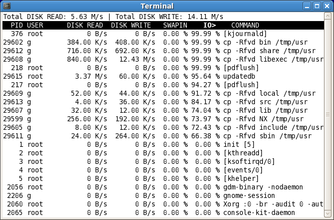 A while back, I linkblogged about "iotop", a
very useful top-like UNIX utility to show which processes are initiating the
most I/O bandwidth.
Teodor Milkov left a comment which is well worth noting, though:
Definitely iotop is a step in the right direction.
Unfortunately it's still hard to tell who's wasting most disk IO in too many situations.
Suppose you have two processes - dd and mysqld.
dd is doing massive linear IO and its throughput is 10MB/s. Let's say dd reads from a slow USB drive and it's limited to 10MB/s because of the slow reads from the USB.
At the same time MySQL is doing a lot of very small but random IO. A modern SATA 7200 rpm disk drive is only capable of about 90 IO operations per second (IOPS).
So ultimately most of the disk time would be occupied by the mysqld. Still iotop would show dd as the bigger IO user.
He goes into more detail on his blog. Fundamentally, iotop works based on what the Linux kernel offers for per-process I/O accounting, which is I/O bandwidth per second, not I/O operations per second. Most contemporary storage in desktops and low-end server equipment is IOPS-bound ('A modern 7200 rpm SATA drive is only capable of about 90 IOPS'). Good point! Here's hoping a future change to the Linux per-process I/O API allows measurement of IOPS as well...
disk iops iotop kernel linux measurement performance storage
#
Under the Covers of Google App Engine Datastore : via James Hamilton. some details on BigTable
French National Assembly reject HADOPI law : 'On Friday the French National Assembly rejected the HADOPI law, which would impose the toughest "three strikes" copyright enforcement law in the world on French Internet users.' phew
UPC block out D-Boxes : Irish cable-TV company UPC have rolled out Nagravision 2 encryption, finally breaking the dodgy "D-Box" decoder boxes sold on a massive scale throughout Ireland for several years now. can't see it staying hacked for long though. NTL's comment: http://url.ie/1g0q
nagravision tv cable-tv encryption security ireland upc ntl d-box
hatful of hollow - Visualising Sorting Algorithms : another dataviz of sorting algorithms, avoiding animation and instead coming up with a nice line-based viz. interesting, but wtf no merge sort ;)
via:simonw sorting algorithms visualization dataviz cairo coding python
Bank of Ireland Credit Card Security: FAIL : if BoI need to verify a transaction out-of-band, they send an SMS to the cardholder asking them to call an unpublished number which diverts to a UK number before demanding all their card details; exactly the modus operandi of a phish. wtf are they thinking?
omgwtfbbq banking boi ireland credit-cards verification security sms via:mulley
#
We have an extremely open-plan layout in work -- no partitions, just long benches of keyboards and monitors. It looks a bit like this, but with less designer furniture and more Office Depot:
Aman pointed out that this is a new trend in workplace design, which Workalicious calls "Big Table Desking":
I'm still not sure what to make of the frequent instances of Big Table Desking. While this kind of workstation arrangement is no doubt a new trend, the no-privacy work place is a throwback to the 1950s office pool, a line up of identical desks classroom style. Is it the peer to peer seating position that overcomes this? How would it? By building community? As opposed the pilot and passenger 747, catholic church model of everybody facing "forward". Does the Big Table Desk break down this heirarchy by facing people towards one another, sharing a big desk instead of staking out territory? Is the big table desk a microcosm, a representation of a healthy organizational structure?
No comment ;)
It seems to be popular with designers, presumably due to their collaborative working needs.
Mind you, it also looks a bit like a Taylorist workplace layout from 1904, of which Wired says:
American engineer Frederick Taylor was obsessed with efficiency and oversight and is credited as one of the first people to actually design an office space. Taylor crowded workers together in a completely open environment while bosses looked on from private offices, much like on a factory floor.
#
Last week I got a very nice mail looking to plug a new music site:
'I'm not sure if this would interest you at all but wanted to pass on the link to a new website called YouBloom.
It's a new social networking and e-commerce website set up with independent artists in mind - to help them to make make real money (unlike MySpace etc which just make money from the artists)! It was set up by Irish Musician Phil Harrington and is backed by Sir Bob Geldof.
Admittedly I am involved with the website. I have been helping bring artists on site for the last few months, since I was introduced to the concept by a friend, but would love for you to take a look at the site anyway - even if it turns out to be of no interest to you.'
I normally wouldn't post these, but I'm a sucker for flattery ;) and the poster had taken the time to read my blog a little. It also looks like the site allows bands to offer free MP3 downloads of their tunes, which IMO is a key factor for bands trying to get promotion.
#
So, after spending an hour or two attempting to figure out where the hell UPC had moved Channel 4 to, I eventually found out that it was now being broadcast on 543 Mhz. I also found out that this wasn't part of the standard list of A1 to A30 channels in the "pal-ireland" range. :(
Thankfully, I then found this Frequency to MythTV channel converter page; here's the correct values to use on the MythWeb channels page:
- Freqid = 30
- Finetune = -4
#
TopatoCo: Time Traveler Essentials Shirt : 'Go back in time wearing this and you'll invent heavier-than-air flight! YOU'LL discover penicillin. YOU'LL be the first to isolate aluminum. Did you know aluminum used to be more valuable than gold? YOU'RE GONNA BE RICH.'
funny history science design clothing t-shirts awesome topato
#
EU to require internet filtering? : essentially mandating IWF-style (ie. half-assed and broken) filtering in all EU countries, I would imagine
Sorting Algorithm Animations : very nice visualizations of insertion, selection, bubble, shell, merge, heap, quick and quick3 sorts
javascript algorithms coding visualization sorting demo via:reddit
blekko's ambient cluster health visualization : nice, custom sysadmin dataviz, via Rich Skrenta
sysadmin data monitoring visualization dataviz operations charts nagios
The reality behind Area 51 : A top-secret 1960's spy plane project called OXCART. 'The shape of OXCART was unprecedented, with its wide, disk-like fuselage designed to carry vast quantities of fuel. Commercial pilots cruising over Nevada at dusk would look up and see the bottom of OXCART whiz by at 2,000-plus mph. The aircraft's titanium body, moving as fast as a bullet, would reflect the sun's rays in a way that could make anyone think, "UFO".' but then -- isn't that what they'd _want_ you to think? ;)
area51 ufo debunking fortean cold-war spy-planes oxcart u-2 nevada history
#
SpamAssassin benchmarked on LLVM : similar to Google's "Unladen Swallow" port of Python. results aren't stellar -- yet -- but there's plenty of room -- and possible contracts
via:matt unladen-swallow google llvm perl porting benchmarks spamassassin speed optimization
#
Scheduled Tasks With Cron on Google App Engine : much needed. 'The App Engine Cron Service allows you to configure regularly scheduled tasks that operate at defined times or regular intervals.'
aws : comprehensive all-in-one perl script giving easy command-line access to Amazon EC2 and S3; very nicely packaged -- installs with a single "curl" command! brilliant
#
downsides of the Akamai IP Application Accelerator : certainly not all roses. (via Tony Finch)
Facebook lose a RAID group : on one of their legacy NetApps? hmm
netapp facebook raid raid5 backup storage data-loss hard-disks
Facebook's Haystack photo storage backend : ditching NetApp and Akamai, rolling their own massive-blob storage cloud
storage scaling facebook web http scalability photos infrastructure distributed haystack cdn cloud netapp
The Game Industry - Push cx : 'Looking in, it's clear that the [computer] game industry is broken and not getting fixed anytime soon. I will not be joining the game industry. I'm interested in building a profitable business making fun games in a good working environment, and that's simply not what it does.' +1; a lot of people, including myself, have also come to that conclusion, over the years
games coding work business management game-industry ea igda quality-of-life crunch-mode mismanagement scheduling
#
Message Queue evaluation notes from Second Life : fantastic research notes; they've identified a lot of niggles and problems with the existing queueing systems out there
messaging scalability queueing rabbitmq mq amqp jms queue secondlife via:proggit
Full data export from discogs.com : awesome! full artist/album/track data for decades of dance music releases, released to the public domain
discogs music dance-music public-domain open-data data tracklistings
comment from RabbitMQ dev regarding the Twitter/Scala/Kestrel drama : 'Writing messaging systems that work under any combination of flows, on any number of machines, and in multiple different reliability scenarios ... is a more interesting problem. Page-to-disk is a way to make RabbitMQ better and address more scenarios.'
rabbitmq disk persistence queueing messaging async twitter scala kestrel
#
Oh man, this Twitter Ruby-vs-Scala language spat is hilarious; talk about handbags at dawn. I loved this exchange in the comments to this post in particular:
I'm mostly surprised that a guy who wrote the book on Scala comes out and says that Scala is better than everything else and someone actually listened and took him seriously. He has a vested interest in saying that Scala is the next big thing and I've yet to see any evidence that Kestrel is better (at anything) than RabbitMQ.
And frankly, I still get fail whales at Twitter on a daily basis, so, what exactly are they so proud about over there?
Kestrel pages queues to disk: if you get more messages than you have memory, it's fine. If RabbitMQ gets more messages than memory, it crashes. We talked to them extensively about this problem and they're going to address it. We were hoping we'd be able to use RabbitMQ or another message queue. We didn't want to be in the message queue business. At this point, given that we know the code and it's performance inside and out, it makes sense to continue using and developing it.
I don't feel like arguing with you but your logic isn't clear to me. It would make sense that if you don't want to be in the message queue business, you'd submit patches against an established message queue to make it work in your situation instead of writing your own message queue, twice. This is overlooking the fact that twitter is basically a massive message queue and you are, in fact, in the message queue business.
Zing!
#
Amazon Removes Delivery Restrictions To Ireland : great news! we can buy electronics on Amazon again
amazon ireland delivery via:mneylon shopping e-commerce electronics
Watch out Broughton! Street View fans plan to descend on 'privacy' village for photo fest : 'it has raised the ire of Internet users, who are now campaigning for Street View enthusiasts from across the UK to descend on the village to snap their own perfectly legal photographs.' ha!
#
A good post from Joshua Schachter about URL shortening services.
For what it's worth, I ran into the unwanted-interstitial risk. At one stage, before I'd bothered registering jmason.org, sitescooper.taint.org or my other domains, I used a URL-shortening service to provide a memorable, short URL for an open-source application I wrote -- http://zap.to/snarfnews/.
At some point a few years down the line, the forwarding process started accreting ads; eventually they became soft-porn in content, and I was forced to apologise to users for the forwarding I could no longer control!
By now, 10 years down the line, it seems to hijack the page entirely, returning a page in Cyrillic I can't even read :( (apparently it's a page of Flash games; thanks, Alexandr Ciornii, for the interpretation!)
Anyway, lesson learned.
#
Damien Katz: Moving To California : another developer moves! a lot of people doing it recently, which worries me; will there be any top expertise left outside of the Bay Area at this rate? we need diversity
Angry villagers run Google Street View out of town : fetch the pitchforks! Street View bin worryin' my sheep! Buckinghamshire yokels fear change
funny privacy uk google street-view buckinghamshire yokels crime paranoia
COBOL ON COGS : 'COBOL ON COGS SUPPORTS STANDARD TERMINALS (VT100 AND IBM 3200) IN THE MOST USEFUL SCREEN CONFIGURATIONS SUCH AS 80X20 AND 40X16' (via Nishad)
#
Twitter has this "Trending Topics" sidebar now, which lists the following topics:
Trending Topics
- TGIF
- National Cleavage
- G20
- Easter
- #grammarsongs
- France
- #rp09
- French
- Grand National
- Report Says Deal
Now, I'm not going to go into the topic of National Cleavage right now. 'Report Says Deal' is intriguing because it makes no sense, until you click through to see:
Real-time results for "Report Says Deal"
dlloydsecret Google to Buy Twitter? Report Says Deal is in the Works http://bit.ly/Wt1Wb
dlloydthemlmpro Google to Buy Twitter? Report Says Deal is in the Works http://bit.ly/Wt1Wb
techupdates [PCWrld] Google to Buy Twitter? Report Says Deal is in the Works http://tinyurl.com/c63ont
icidade Google to Buy Twitter? Report Says Deal is in the Works. http://is.gd/quu9
chrisgraves Retweeting @CinWomenBlogger: Retweeting @ays: Google to Buy Twitter? Report Says Deal is in the Works - PC World http://bitly.com/LhT4
So I'd say that Twitter's "Trending Topics" uses N-grams of between 1 and 3 "words" for topic identification. In this case, rather than "Report Says Deal", a better topic string would be something like:
Google to Buy Twitter? Report Says Deal is in the Works - PC World
or even:
Google to Buy Twitter? Report Says Deal is in the Works - PC World http://bitly.com/LhT4
Funnily enough this is exactly the issue I ran into while developing this algorithm. The trick at this point is to apply a variant of the BLAST pattern-discovery algorithm, expanding the patterns sideways while they still match the same subsets of the corpus until they're maximal.
Twitter folks, if you can read Perl, "assemble_regexps()" in seek-phrases-in-log in SpamAssassin SVN does this pretty nicely, and reasonably efficiently, and is licensed under the ASL 2.0. ;)
#
Warren Ellis » The Conclusion Of BATTLESTAR GALACTICA (Condensed Version) : hahaha, spot on
bob-dylan bsg funny religion deus-ex-machina warren-ellis via:fp
Easy AI with Python - PyCon 2009 : 'several basic AI techniques implemented with short, open-source Python code recipes ... For each technique, learn the basic operating principle, discuss an approach using Python, and review a worked out-example. We'll cover database mining using neural nets, automated categorization with a naive Bayesian classifier, solving popular puzzles with depth-first and breath-first [sic] searches, solving more complex puzzles with constraint propagation, and playing a popular game using a probing search strategy.' video: http://pycon.blip.tv/file/1947373/
python problem-solving games puzzles ai search constraint-propagation depth-first breadth-first
Amazon Elastic MapReduce : excellent! run Hadoop jobs on EC2, with data hosted on S3. essentially, AWS have integrated a Hadoop dashboard to provide a great web-based and command-line UI
Arthur Kade meets Angelina Jolie : best blog ever. Narcissistic meathead 'actor/model' type waxes lyrical on how Angelina Jolie is '"mother hot", rather than "stripper hot"': 'I would probably rate her an 8.5-9 on my looks scale. I am not that sure that I would even feel the need to come up and initiate a conversation with her if I met her out somewhere.' 'I couldn't really say that she would stick out for me if I saw her at a hot club like 1Oak or Rosebar.' The entire blog is solid gold idiocy; I'd swear it was fake, but apparently not
wtf funny arthur-kade blogs narcissism angelina-jolie via:gerry stripper-hot beauty
Google uncloaks once-secret server : GOOG's servers include built-in 12V batteries (and of course lots of velcro). video: http://www.youtube.com/watch?v=xgRWURIxgbU (via wmf)
via:wmf google hardware servers infrastructure batteries electricity energy data-center efficiency pue
#
Wrong Tomorrow - pundits vs. time : great idea from Maciej Ceglowski
pundits windbags bullshit journalism trends futurism future prediction experts wrongtomorrow forecasting futurology predictions
Stable URLs in Mailman mailing list archives : hooray. I requested this ages ago, it's now being implemented
archival mailing-lists web uris mailman urls addressing permanence mail discussion
Not-so-open Cloud Manifesto rains on interoperability parade : 'The controversy surrounding the Open Cloud Manifesto demonstrates the risk of trying to build interoperability behind closed doors and through exclusionary practices. Such environments are not conducive to building consensus, which is one of the key ingredients of successful standards.'
collaboration cloud-computing sun open-source open standards politics vendors
Continuous deployment in 5 easy steps : more on IMVU's continuous-deployment concept. interesting that they halt SVN commits on CI build failure, that seems extreme
imvu deployment software coding sysadmin testing automation build ci process agile continuousdeployment
faceboards.ie : Boards.ie a la Facebook, for April 1. thing is, I think I prefer this UI
#
The Snooping Dragon : awesome, if terrifying research from Shishir Nagaraja and Ross Anderson on Chinese cyber-surveillance of the Tibetan movement. 'we described how agents of the Chinese government compromised the computing infrastructure of the Office of His Holiness the Dalai Lama. They used social phishing to install rootkits on a number of machines and then downloaded sensitive data. People in Tibet may have died as a result.'
phishing social-phishing dalai-lama security surveillance privacy law china ross-anderson research papers windows microsoft
#
It's two days until OSSBarCamp, a free open-source-focussed Bar Camp unconference at Kevin Street DIT, this Saturday. I'm looking forward to it -- although unfortunately I missed the boat on giving a talk. (Unlike the traditional Bar Camp model, this is using a pre-booked talk system.)
Particularly if you're working with open source in Ireland, you should come along!
I have high hopes for John Looney's discussion of cloud computing and how it interacts with open source. Let's hope he's not too Google-biased in his definition of "cloud computing". ;)
Also of interest -- Fintan Boyle's "An Introduction To Developing With Flex". To be honest, I hadn't even realised that Adobe Flex was now open source. cool.
#
German Police Raid Homes of Wikileaks.de Domain Owner : "what the Australian government's secret ACMA internet censorship blacklist has to do with Germany is a mystery. This case is a prime example of multiple governments collaborating in support of censorship." worrying.
Fast polling using C, memcached, nginx and libevent : well-written worked-through example of a classic memcached-backed libevent front-end caching system
http memcached caching optimization scalability plurk libevent nginx polling c
"The Powers That Be Want Action Taken" : 'Gardai were in the [Today FM] offices yesterday looking for email communications between the team and the artist. According to D'Arcy the team were told [..] that "the powers that be want action taken"." ffs! how's about taking action against the fraudsters who've bankrupted our country instead? appalling diversionary tactics
diversions gardai picturegate brian-cowan art pranks today-fm ray-darcy censorship
AWS Toolkit for Eclipse : 'Eclipse extensions automatically configure remote debugger connections for diagnosing problems and debugging software run in the cloud' -- ie. you can set a breakpoint on code running remotely, at EC2. that's pretty awesome (via Steve Loughran)
via:steveloughran aws ec2 programming java plugins development eclipse cloudcomputing tomcat
Ask a Flowchart: Which Blowhard Am I? : YES
blowhards funny internet web2.0 magazines wired flowcharts dave-winer
Zooko laid off by AllMyData.com : looks like AllMyData are facing a money crunch ("focussed on keeping costs down"). hopefully this isn't bad news for Tahoe, the fault-tolerant open-source distributed filesystem -- or indeed for Zooko himself
allmydata zooko money tahoe filesystems storage fault-tolerance funding open-source distributed scalability
RTE Apologise to Brian Cowen for Nudie Pics Report : the national broadcaster apologises, on air, for a news story covering the 'paintings of an Taoiseach in the nude' prank. wtf!
rte television freedom-of-speech censorship satire wtf apologies soft weakness
#
Australian ISP abandons blocking : "We are not able to reconcile participation in the trial with our corporate social responsibility, our customer service objectives and our public position on censorship," iiNet managing director Michael Malone said. "It became increasingly clear that the trial was not simply about restricting child pornography or other such illegal material, but a much wider range of issues including what the Government simply describes as 'unwanted material' without an explanation of what that includes."
Akamai have developed a parallel internet : and, most surprising of all, it _works_. holy crap. (thanks Antoin!)
ip-application-accelerator akamai internet routing speed network networking ip latency joelonsoftware copilot via:antoin
Guerilla artist hangs nude Cowen paintings : some prankster put up rather disturbing paintings of Ireland's taoiseach in the National Gallery and Royal Hibernian Academy. "'It's reasonably well painted. It's not the worst thing I've ever seen,' conceded James O'Halloran of Adam's Fine Art Auctioneers & Valuers."
painting pranks ireland galleries brian-cowan politics funny
#
New Zealand Halts Internet Copyright Law Changes : excellent. good result from their blackout, then
new-zealand copyright p2p technology freedom politics internet copyfight blackouts protests
Jungle Disk/Cloud Files scalability woes : Rackspace had to firefight over the weekend to deal with scaling issues with JungleDisk users backing up to their Mosso Cloud Files service. now fixed with a JungleDisk upgrade (2.60c): http://blog.jungledisk.com/2009/03/23/jungle-disk-260c-released-cloud-files-access-restored/
jungledisk ouch mosso cloud-files scaling online-backup backup caching s3 storage
Puppets, chefs, and community competition : open source intra-project poaching between the Puppet and Chef deployment automation projects
lwn puppet chef open-source poaching staff contributors developers coding
Creator of Cyc reviews Wolfram Alpha : the hand-curation of its source knowledge base sounds incredibly labour-intensive (and expensive)
cyc wolfram wolframalpha ai search data ontology semantic-web via:yoz
interview with a 419er : 'i know my God will forgive because i pray to him to replenish the pockets of my clients [read: victims] with double of whatever they loss'
security spam chat scam 419 fraud chat-log religion via:waxy
#
On Monday April 20th, the Heritage Society of Engineers Ireland, in association with The Irish Computer Society, and the ICT and Electronic and Electrical Divisions of Engineers Ireland, will be hosting an evening lecture: 'Reminiscences of Early days of Computing in Ireland':
In 1957 the Irish Sugar Company installed the first stored program computer in Ireland. Other large organisations slowly followed suit.
Gordon Clarke will discuss how the early computers enhanced the electro-mechanical systems that had developed over the previous 60 years. He will talk about their specifications, a few of the first applications and tell the story of the very early years of designing and developing computer based systems.
All Welcome. Admission Free. No booking required. This event will be web-cast
For Details: www.engineersireland.ie, or Con Kehely: (01) 6860113 (con.kehely /at/ dublincity.ie)
Location: Engineers Ireland, 22 Clyde Road D4
Sounds great! Thanks to Frank Duignan on the ILUG list for forwarding the notice.
computers computing dublin events gordon-clarke history ireland talks
#
Election Officials Arrested, Charged With 'Changing Votes at E-Voting Machines' : the circuit court judge, the county clerk, and election officers of Clay County,KY were all arrested and indicted for 'changing the votes at the voting machine', and showing others how to do it, over the course of 2002-2006; they'd send the voters away at the confirmation screen, then go back and change their votes
#
In the comments to this unremarkable story about 4chan's Boxxy fad, I came across this gem from CSClark:
I don't know why I didn't think to see if this sort of phenomenon was covered in Extraordinary Popular Delusions... Of course, it is.Walk where we will, we cannot help hearing from every side a phrase repeated with delight, and received with laughter, by men with hard hands and dirty faces, by saucy butcher lads and errand-boys, by loose women, by hackney coachmen, cabriolet-drivers, and idle fellows who loiter at the corners of streets. Not one utters this phrase without producing a laugh from all within hearing. It seems applicable to every circumstance, and is the universal answer to every question; in short, it is the favourite slang phrase of the day, a phrase that, while its brief season of popularity lasts, throws a dash of fun and frolicsomeness over the existence of squalid poverty and ill-requited labour, and gives them reason to laugh as well as their more fortunate fellows in a higher stage of society.
Wherein we also learn that the FAIL of the day was Quoz:
I'm also sure I've read of a fad - Greek, Roman, 18th century, something like that - where a group of young (aristocratic?) men who would suddenly grab a common woman and proclaim her Helen and make her their queen and swear to die for her and so on. And the tearing down of such idols could be seen, if you were wont to be pretentious like me, as part of Frazer's Golden Bough's Sacrificial King idea, although I'm not sure script kiddies care if the crops grow. (One other problem with that is that Frazer was romancing; but so are the more literal memecists, so yah!)When a disputant was desirous of throwing a doubt upon the veracity of his opponent, and getting summarily rid of an argument which he could not overturn, he uttered the word Quoz, with a contemptuous curl of his lip, and an impatient shrug of his shoulders. The universal monosyllable conveyed all his meaning, and not only told his opponent that he lied, but that he erred egregiously if he thought that any one was such a nincompoop as to believe him.
Since then however, it appears that "quoz" has entirely flipped meaning, according to UrbanDictionary:
slang for quality, a cockney term for something good. usually accompanied with a hand action of slaping ur index finger against the stationary thumb and middle finger. 'thats quoz man! propa quoz.' finger slappy hand thingy
19th-century 4chan boxxy crowds extraordinary-popular-delusions fads fail memes quoz
#
cloudkick : "the easiest way to manage the cloud". supports EC2 and slicehost servers, provides metrics, graphing, and basic monitoring. looks very nice! (via JK)
via:jkeyes amazon aws ec2 hosting scalability sysadmin deployment management server slicehost vps cloudkick
AnandTech: The SSD Anthology: Understanding SSDs and New Drives from OCZ : SSDs lose performance noticeably after an initial honeymoon period, once their block map starts to contain previously-allocated blocks. benchmarks for this factor will be critical in SSD measurement
ssds storage intel anandtech reviews benchmarks speed disk hardware flash solid-state
#
Using Btrfs with Multiple Devices : cool. looking forward to this settling down so I can play with it
ClamAV now supports Google's Safe Browsing blocklist : 'treat such data as a potential risk, that is a suspicious source of malware.' 'mainly targeted at people who are using ClamAV to filter web traffic.' (via fanf)
via:fanf security clamav antivirus antiphishing google safe-browsing blocklists
Alexander Larsson summarises ext4 vs fsync : good writeup of the current state of play
fsync ext3 ext4 filesystems linux sync crash-recovery safety reliability
more "top"-like utilities : htop (top with a fancy UI), iftop (top for IPs on the network) and iotop (top for per-process I/O statistics). hadn't heard of htop or iotop, so this is useful. all are "apt-get"able on 8.10. (update: Craig reminded me of "atop" -- another great util, with excellent historical process monitoring ability)
htop iotop via:wmf iftop top processes unix sysadmin performance profiling commandline ubuntu
#
Killer presentation -- "RPC And Its Offspring: Convenient, Yet Fundamentally Flawed" from Steve Vinoski, who presented it at QCon London last week. It's full of reminders of the mid-90's, hacking away on CORBA technology -- Steve was one of the key players at Iona while I was there.
But never mind where we've been; let me hit you with the summary slide to show where Steve's going:
- RPC is a convenient but flawed accident of history
- 1980s research focused on monoliths of programming languages, distributed applications, and operating systems
- each computer vendor of the time owned their own full stack, from language to hardware and network, and you used what they gave you
imperative languages won back then simply because of their superior performance at that time
It's almost 2010, folks — we can do WAY better
- pull your head from the imperative language sand and learn functional programming
- the world is many-core and highly distributed, and the old ways aren't going to keep working much longer
Awesome ;)
coding corba distcomp erlang presentations rest rpc software steve-vinoski
#
Mosso Cloud Servers : very interesting! lowest price is $0.015/hr, ie. $10/month; quite a lot cheaper than the EC2 option. no equivalent to S3 though
ec2 s3 virtualization rackspace mosso hosting scalability servers cloud grid server
RTÉ Storyland : vote for my mate Luke's film: "Psych Ward". it's great!
Concurrence : impressive libevent-based Python async-I/O framework. looks like it hides async code's complexity nicely (via SimonW)
web via:simonw stackless framework asynchronous concurrence async libevent messaging concurrency python scalability performance
Ts'o: Delayed allocation and the zero-length file problem [LWN.net] : epic LWN thread on this ext4 misfeature. I'm ambivalent: it's perfectly POSIXly-compliant for ext4 to do this, but it _will_ cause data loss for me. I'll be using 'nodelalloc' if this is still in a released version
data-loss crash ubuntu linux ext3 ext4 fsync sync filesystems reliability durability lwn nodelalloc
#
how to create a tmpfs ramdisk which "spills over" onto a disk filesystem at a certain size : neato LVM hack
how useful are the new SEI grants for green upgrades to Irish homes? : doesn't sound great. this site reckons it'd take 21 years to break even on your investment if you chose external wall insulation
insulation green environment house home sei ireland builders
#
TechWire: ISPs' reaction to Eircom/IRMA deal: too little, too late : 'What it does not say is that Irish ISPs will fight any attempt by the music industry to coerce them into blocking websites of Irma's choice. It could have said this. But it deliberately didn't. Because ISPs will not rule this course of action out.'
#
I just made a loan using Kiva.org to a weaver in Nepal and a group of Vietnamese broom makers.
You can go to Kiva's website and lend to someone in the developing world who needs a loan for their business. Each loan has a picture of the entrepreneur, a description of their business and how they plan to use the loan so you know exactly how your money is being spent -- and you get updates letting you know how the entrepreneur is going.
The best part is, when the entrepreneur pays back their loan you get your money back - and Kiva's loans are managed by microfinance institutions on the ground who have a lot of experience doing this, so you can trust that your money is being handled responsibly.
Kiva's microfinancing seems like a nice way of helping the developing world, and I've heard good things about it. Here's hoping it works out well for my two recipients!
#
MetaSVM SpamAssassin plugin : a new alternative scoring plugin -- learn mail classification (ham or spam) based on an SVM applied to the SpamAssassin rules hit, instead of the static "additive scores with 5-point threshold" model. very nifty!
spamassassin plugins scoring metasvm svm classification classifiers machine-learning anti-spam
Did BBC break the law by using a botnet to send spam? : Graham Cluley of Sophos weighs in
BBC programme broke law with botnets, says lawyer : upcoming Beeb program demonstrates the use of a 22000-node botnet to send spam and DDOS-attack a host, and one lawyer asserts that their programme-makers' actions were illegal
#
Erlangst : 'Erlangst (n): The fear that (subject) is not smart enough to program in, or even comprehend, the Erlang programming language.'
Startup Ireland : 'designed to provide a home for all information that an entrepreneur might find useful when starting a company in Ireland.'. Good idea Joe!
Amazon EC2 Reserved Instances : bulk-buy EC2 instance-hours in advance; either 1 year for $325 or 3 years for $500. great news, much more competitive now against a dedicated colo server
#
SSL session resumption is essential : something worth checking if you admin an SSL site; "Session ID Length" == 0 is the tell-tale
kids are starting to prefer MP3s to artifact-free music : 'Jonathan Berger, professor of music at Stanford [.. notes that] students [..] prefer "sizzle sounds" that MP3s bring to music. It is a sound they are familiar with.'
music mp3 sound compression audio students psychology quality perception artifacts via:slashdot
Building a 1.8 exabyte data center : 'Building an exabyte data center is feasible. All it takes is money - $400 million with all the goodies - and power. Time to readjust the mental model of storage possibility. Other than the NSA's acres of disk at Fort Meade though, I'm not aware of any exabyte data centers.'
ouch exabyte datacenters storage disk hardware provisioning nsa racks planning petabytes
#
So, if you use Google Reader, read your news with the "All items" page, and are subscribed to hundreds of feeds, it can be pretty overwhelming. I've found a better way to deal with this.
Select a 'most important' subset of feeds. For each of those, click through to the feed details page, hit the "Feed Settings..." menu, and select "Change folders...". Put the feed into a new "top" folder (creating it if necessary).
Now go to "Settings" -> "Preferences" and check out the "Start page" preference. By default, it's set to "Home"; change it to "Folders and Tags: top".
Hey presto -- now, when you load Google Reader, it'll come up with your "top" items. You can get through those quickly enough, and get on to other more important tasks. When you're bored and need something to read, though, just hit "Navigation" -> "All items" (or even just type 'ga'), and every other feed is now there for your delectation. Sweet!
atom feeds google google-reader hacks lifehacks productivity reader rss ui
#
Dustin Kirkland: When is Amazon's EC2 appropriate for your workload? : a little helper app for Ubuntu. cute (via Danny)
SpamAssassin running off the grid : powered by a wind generator and some solar panels, to be exact, in the remote northwest of Scotland (plenty of wind there!)
scotland wind-power spamassassin linux servers electricity power
HubLog: Making a Lucene index of Wikipedia for MoreLikeThis queries : nice contextual hack
context wikipedia search bbc lucene solr indexing freebase hublog php
SUB-MIT: The Great McMurdo Jello-Wrestling All-Hands Meeting : pen-pushing on the polar frontier
bureaucracy denver funny mcmurdo south-pole jello jello-wrestling wtf all-hands meetings pen-pushers bigdeadplace
pHash - the open source perceptual hash library : 'a fingerprint of an audio, video or image file that is mathematically based on the audio or visual content contained within. Unlike cryptographic hash functions which rely on the avalanche effect of small changes in input leading to drastic changes in the output, perceptual hashes are "close" to one another if the inputs are visually or auditorily similar.'
video audio open-source sound signature search hashing algorithms fingerprint phash perceptual hash similarity
#
Telenor shuns IFPI's 'block Pirate Bay' demands • The Register : '"Asking an ISP to control and assess what internet users can and cannot download is just as wrong as asking the post office to open and read letters and decide what should and should not be delivered," said Telenor.'
#
SmartBear CodeCollaborator : very nifty-looking code-review tool. supports R-T-C and C-T-R, lots of subscription/notification options, real-time web-based inline chat, open data store, and custom script triggers (via Henning on ASF members list)
via:henning code-review coding programming review tools agie smartbear c-t-r svn p4 git
Using Hadoop to fight spam : Mark Risher and Jay Pujara @Y! Mail talk about their use of Hadoop's Pig and Streaming products in anti-spam number-crunching
mark-risher jay-pujara yahoo yahoo-mail anti-spam hadoop pig stream video
Simon Wistow bemoans git's tendency to permit siloing : the ruby-oauth gem now has 27 forks on github. ffs
ruby git forking github dvcs forks open-source hazards moan siloing
#
Reminder -- Ireland's Blackout Week starts tomorrow:
Take part in Blackout Week
- To demonstrate your feelings about [IRMA's censorship demands], you can make your avatar black on any websites you have a presence on.
- This is inspired by Creative Freedom New Zealand's blackout campaign.
- From Black Thursday on the 5th of March, for one week, set your picture on sites like Facebook, Bebo, Twitter, MSN, etc black to raise awareness for Blackout Ireland.
- On that Thursday we encourage you to express yourself publicly about this issue, whether by blog posts, letters to newspapers or any form of communication you can think of.
#
Locale : 'Locale allows you to create Situations, which specify Conditions under which your Settings should change; e.g. your "At Work" situation might notice when your location condition is "1600 Amphitheatre Parkway," and trigger your ringer to vibrate.' in essence, rule-based AI for your phone. want it! and the phone too while I'm at it!
#
Here's a great idea from a thread on the SpamAssassin users list, from Roger Marquis:
Karsten Bräckelmann [questioning the utility of a mechanism to dump the entire contents of the SpamAssassin configuration database]:
'postconf' without the handy -n switch dumps about 500 lines. The equivalent dump for SA including the rules is about 6000 lines. And that's a plain dump, without following and unfolding meta rules or anything.
Whether 6K or 60K would not necessarily make a difference to how I would like to use an SA 'postconf -n' equivalent. That use is change management. The intent is not in the full report itself but in its deltas.
As full time mail/systems admins we get invaluable data from tripwire/integrit, 'postconf -n', dconf, 'rpm -qa', 'dpkg -l *', 'pkg_info -a', ... whose output is checked in to RCS daily. This provides a nice configuration snapshot and historical record but its real usefulness comes from rcsdiff piped into a daily report. These are (usually) relatively concise, and IMO, absolutely essential for monitoring production Unix/Linux systems.
I like it! I think I'd check it into a git repo, though. The concept of applying VC smarts to traditional sysadmin tasks is definitely a meme on the way up -- see also etckeeper.
#
LightCloud - Distributed and persistent key-value store : built on Tokyo Tyrant, performance comparable to memcached, scale by adding nodes, supports hot backup/restore, used in production by Plurk.com, mixi.jp and scribd.com. interesting
plurk python scaling storage databases scalability memcached distributed dht db persistent tokyotyrant lightcloud tokyocabinet via:joshua
10 Papers Every Programmer Should Read (At Least Twice) : actually a very good list. some interesting papers here I hadn't heard of, particularly _ An Experimental Evaluation of The Assumption of Independence in Multi-Version Programming_ (1986)
coding history programming papers toread education academia cs
/~colmmacc/ - Optimising strlen() : good post on various approaches to code optimization of a particularly common C idiom -- strlen(). I'd never seen the glibc "add to unsigned long to detect zeroes" trick before -- very nifty!
#
Bord Gáis Energy - The BIG Switch tariffs : hmm. a lot of PR spooge, but not a very good deal; Airtricity are 8.4% cheaper per kWh and 11% cheaper than ESB
electricity ireland consumer bord-gais airtricity prices savings
(UPDATE: I was wrong! Airtricity are quoting ex-VAT. see comments below.)
#
Worldchanging: Bright Green: The Last Viridian Note : Bruce Sterling says, "buy a good bed". great stuff
bruce-sterling viridian design philosophy ideas worldchanging sustainability simplicity green environment stuff future culture
Xbox LIVE gets Universal Pictures content : Irish and UK Xbox Live users can now download movies. unfortunately, they only offer 30 of them! FAIL
fail xbox-360 xbox-live via:laura ireland universal-pictures
How FriendFeed uses MySQL to store schema-less data : what a hack! basically using MySQL as a replicated, highly-scalable storage engine and ignoring many of the RDBMS features to avoid schema change locks
mysql hacks scaling storage scalability schema schemaless blob friendfeed sql database
#
As Adrian noted last week, IRMA are demanding that Eircom block the Pirate Bay -- first on a list of websites they don't like -- on pain of being sued. On top of that, they intend for the other Irish ISPs to follow suit -- here's a key line from the letter they sent to Blacknight MD Michele Neylon:
in the event of a positive response to this letter it is proposed to make practical arrangements with Blacknight of a like nature to those made with eircom.
If that comes to pass, this will be an appalling situation for Irish internet users, and we need to act to ensure it doesn't happen. Digital Rights Ireland:
The net effect of this scheme, if it is allowed to go into effect, will be to impose an internet death penalty on two groups. On users, who will be cut off on the allegation of a private body, with no court involvement, and on websites, which could be blocked to Irish users based on a court hearing where only one side is heard.
Pace Mulley:
So first they'll start with the Pirate Bay. Then comes Mininova, IsoHunt, then comes YouTube (they have dodgy stuff, right?), how long before we have Boards.ie because someone quoted a newspaper article or a section of a book?
Digital Rights Ireland have posted an excellent document detailing the following plan of action for Irish internet users concerned about this:
-
Contact your ISP and let them know that this is a key issue for you, as their customer.
-
Join up with your fellow netizens. Subscribe to the Blackout Ireland blog. Follow the #blackoutirl hashtag on Twitter. Join the Blackout Ireland Facebook group. It looks likely that there'll be a week-long blackout campaign starting next Thursday, March 5th.
-
Contact politicians. This is likely to cause irreparable damage to the Irish internet, so our pols should be very worried. See the DRI post for details on getting in touch with Minister for Communications Eamonn Ryan.
New Zealand is running their own blackout campaign right now, so that may help our planning.
International readers -- make no mistake, you're next. IRMA in this case is acting as the local delegate of IFPI, which stated in 2007 that this was one of the 3 technical options for ISPs to control piracy:

Here's some other interesting coverage:
Fantastic interview with BitBuzz CEO Alex French:
If ISPs, including Eircom, agree not to oppose blocking access to The Pirate Bay and other similar websites, is this not an agreement to web censorship? "I don't think there is any other way to interpret it," said French.
"They are essentially agreeing to censor certain websites at the behest of the recording industry, without these websites ever having necessarily shown to be illegal in the Republic of Ireland. I would have a huge concern over what other websites may be blocked and what other industries will pile in now that the precedent has been set."
Some sample letters:
-
letters to IRMA, and to Minister Eamon Ryan from Paul McCarthy
-
A sample letter to your ISP from Charles Julienne
And further discussion -- here's a massive boards.ie discussion thread, now closed in favour of this newer thread.
Update: here's the letter I sent to the Minister, if you're curious or need inspiration.
blackoutirl eircom filesharing grassroots ifpi internet ireland irma isps pirate-bay politics
#
despotify : open source Spotify client; its developers reversed the Spotify closed protocol. however, it's just blocked users with 'Free' accounts, which renders it useless; hopefully someone will fork and fix this soon
mailfront : 'a package containing customizeable network front-ends for mail servers': SMTP, QMQP, QMTP, POP3. a bit like qpsmtpd written in C. JL has apparently written a SpamAssassin plugin for it
Gerrit : web-based code review tool for Git-based projects. very nice
ISPs "could block" access to music labels' websites : heh. quite a nice technical response; 'such sweet revenge would take the form of blocking access to the websites of EMI, Sony, Universal, Warner and IRMA, among others. Their approach: you piss on our turf, we'll piss on yours.'
isps ireland funny revenge irma emi sony universal warner-music adrian-weckler
Jorn's on Twitter! : "Web 3.0 is going to be about filtering Web 2.0". nice
trends jorn-barger robotwisdom twitter rt web2.0 web3.0 future filtering anti-spam
#
Facebook group against the IRMA action : entitled 'let's ensure that we have an uncensored Internet for Ireland'
Blacknight post a copy of the IRMA letter : in full, as a 3-page PDF scan
blacknight letter scans irma filesharing piratebay isps ireland law copyright
Ryanair - Their Attitude To Online PR Part Of A Bigger Reputation Problem : wow, this is really blowing up. great stuff ;)
ryanair car-crash disaster reputation media travel ireland jason-roe blogging funny
how the Italian ISPs "blocked" piratebay.org : they simply intercepted DNS requests for their zones, returning 127.0.0.1. using OpenDNS evades that
blocking censorship italy piratebay opendns dns filtering isps eircom slashdot
debunking "Facebook causes cancer" : two scientists, Prof. Susan Greenfield and Dr. Aric Sigman, promulgating the worst kinds of fake science. disappointing
science facebook media health badscience cancer daily-mail susan-greenfield aric-sigman
Datamoshing : the use of artificially-induced video compression artifacts for artistic effect, as seen in Chairlift's "Evident Utensil" and Kanye's "Welcome to Heartbreak" videos
compression artifacts video mpeg datamoshing music via:kottke art effects kanye-west chairlift music-videos cool
Explanations to common Java exceptions : 'CharConversionException: You have been trying to incinerate something noncombustible. It is also possible that you have tried turning yourself into a fish, but that's rare.'
via:nelson funny geeky programming java exceptions language reference
#
Introducing Karmic Koala, Ubuntu 9.10:
What if you want to build an EC2-style cloud of your own? Of all the trees in the wood, a Koala's favourite leaf is Eucalyptus. The Eucalyptus project, from UCSB, enables you to create an EC2-style cloud in your own data center, on your own hardware. It's no coincidence that Eucalyptus has just been uploaded to universe and will be part of Jaunty - during the Karmic cycle we expect to make those clouds dance, with dynamically growing and shrinking resource allocations depending on your needs.
A savvy Koala knows that the best way to conserve energy is to go to sleep, and these days even servers can suspend and resume, so imagine if we could make it possible to build a cloud computing facility that drops its energy use virtually to zero by napping in the midday heat, and waking up when there's work to be done. No need to drink at the energy fountain when there's nothing going on. If we get all of this right, our Koala will help take the edge off the bear market.
AWESOME -- exactly where the Linux server needs to go. Eucalyptus is the future of server farms. Really looking forward to this...
#
Ryanair PR staff issue statement complaining about "idiot bloggers" : "It is Ryanair policy not to waste time and energy corresponding with idiot bloggers and Ryanair can confirm that it won't be happening again". hilarious! dicks
Sunday Business Post: Music-swapping sites to be blocked by internet providers : IRMA will provide Irish ISPs with a list of alleged file-sharing sites, and will take legal action if those sites are not blocked. Eircom at least are allegedly legally required to comply. need to look into this a bit more, but this sounds incredibly serious at first glance
irma ireland filtering censorship eircom piratebay isps chilling-effects via:adrianweckler dri filesharing
Offensive Words List Released by Message Partners : 'Message Partners released into the public domain the world's most extensive offensive language list for use with a spam filter. This offensive word list includes hundreds of thousands of permutations of sexually explicit language.'
Web2Ireland Facebook Developer Garage March 2009 : 'a place to explore, get gritty, tinker, experiment, and test out ideas for Facebook Platform', 5 March, Digital Exchange
Avoid the EUR10 credit card charge when booking with Ryanair : bookmarking, in case I ever have to fly Ryanair in future (hopefully not)
ireland ryanair consumer credit-cards visa debit-cards entropay flights money travel
Jason Roe finds bug in Ryanair site, Ryanair staff act like assholes in the comments : 'We very well know about these anomalies and unless it is not critical we are not going to sacrifice time to this. If you would be a serious programmer you would know these things'
wankers ryanair travel flights funny blogging jason-roe bugs web serious-programmers
OSS Bar Camp Schedule : really need to get off my arse and get writing
ossbarcamp oss open-source barcamp talks dublin events conferences
#
 Somehow or other, I seem to have won the 2009 Irish Blog Award for Best Technology Blog/Blogger!
To be honest, for the last year I haven't been spending as much time on the blog as before, due mainly to a rather compelling distraction, so I'm doubly grateful for winning.
Unfortunately, I was out of the country, at Nishad and Janet's wedding, so missed my chance to get up on stage and thank my fellow bloggers in person -- but I asked John to do so instead. Seems he in turn got stage fright and delegated to his missus, who picked up the trophy. Thanks Fiona! That's probably just as well, since I'm pretty incoherent in that kind of situation myself.
Cheers to my fellow nominees, Eoghan, Robin, Michele and Pat. One of you guys should totally have won ;)
And last of all -- cheers to BitBuzz for sponsoring the category, and Mulley for the whole bash. I definitely have to turn up next year!
Now I need to put more time in this year to really earn that award...
#
Transactions Across Datacenters (and other weekend projects) : presentation by GAE's Ryan Barrett
transactions internet wan replication backup concurrency paxos ryan-barrett distcomp
Mac OS X Security Update 2009-001 might break your Perl : it included parts of an old perl module, breaking anyone who uses CPAN. nice work, Apple
#
Blimey, I'm a finalist for one of this year's Blog Awards:
Best Technology Blog/Blogger - Sponsored by Bitbuzz
Unfortunately I'm going to be in LA this weekend, so I'll need to give a written message to John, just in case the impossible happens ;)
#
Pho recipe : recommended by katyusha and mrn!
ClubOrlov: Social Collapse Best Practices : more cheery stuff from Dmitry Orlov, this time in much greater depth than the "Collapse Gap" slides
orlov collapse usa russia economy recession food history politics survival crisis long-now
Deploying Django with Fabric : Django community's take on Capistrano. looks really complex, configured by writing a load of Python. ugh
django capistrano deploy server linux webdev sysadmin deployment git fabric
Good walkthrough of setting up a modern Ubuntu box to host multiple Django sites : using nginx, Apache 2, Django, memcached, mod_wsgi and PostgreSQL. interesting to see virtualenv in use; in Perl-land, ExtUtils::MakeMaker takes care of this for us nicely using "perl Makefile.PL PREFIX=...". also, deploying directly from a "git push"
deployment git nginx apache django memcached python mod_wsgi postgres virtualenv sysadmin ubuntu webdev linux install
#
So it seems that JC Decaux have been complaining about the costs of running the Velib scheme in Paris:
Since the scheme's launch, nearly all the original bicycles have been replaced at a cost of 400 euros each.
Of course, this won't be a problem in Dublin. Going by Newstalk's estimates of how much the advertising space provided to JC Decaux for free, in exchange for the (as yet nonexistent) 450 bikes would have cost, each bike comes at a public cost of 111,000 Euros. That should cover a lot of "velib extreme".
(OK, that may be overestimating it. The Irish Times puts a more sober figure of EUR 1m per year; that works out as EUR 2,000 per bike per year. Still should cover a few broken bikes.)
A quick reminder:
| Paris | Dublin |
|---|---|
| 20,000 bikes | 450 promised |
| ~1,600 billboards | ~120 installed |
| ~12.5 bikes per billboard | ~3.8 bikes per billboard |
| 10km range (from 15e to 19e arondissement) | 4km range (from the Mater Hospital to the Grand Canal) |
And, of course, there's no sign of the bikes here yet... assuming they ever arrive. Heck of a job, Dublin City Council.
BTW, here's the rate card for advertising on the "Metropole" ad platforms, if you're curious, via the charmingly-titled Go Ask Me Bollix.
#
How Not To Sort By Average Rating : the correct way to produce a sort index given a set of [ positive_ratings, negative_ratings ] pairs; apparently it's the lower bound of the Wilson score confidence interval for a Bernoulli parameter. great, this may work well for SA's rule-QA system too
spamassassin rule-qa algorithms stats statistics sorting ranking popularity average maths
"F{N}OSS!" : 'Free Software and related commentary from the Nordic region.' I wonder if there's room for one of these for the Isles, ie. UK and .ie? although mind you planetilug probably takes care of the .ie part already
blogs opensource floss finland norway planet sweden community open-source
The Costs of Continuous Deployment : Steve Loughran with a little bad news on yesterday's post. 'CI is like a chainsaw: very powerful, can achieve great things, but if handled badly you can cut your own legs off and that hurts.'
steve-loughran c-i continuous-integration continuous-deployment deployment ant rollout
#
Hey Gmail users! If you're using Tasks, there's a slightly annoying bug in Gmail right now -- you may see the "Use this link to open Tasks" tip window appear every time you access the inbox page.
Several other people have reported it, and apparently the Google guys are 'working to resolve it' at the moment. In the meantime, though, here's a way to work around the issue without losing Tasks (you will, unfortunately, lose the offline-gmail functionality, though). Simply disable Offline Gmail (Settings -> Offline -> "Disable Offline Gmail for this computer"), and the bug no longer manifests itself.
You can allow Gmail to keep the stored mail on your computer if you like, which will be handy for when the bug is fixed and Offline can be re-enabled -- hopefully sooner rather than later.
#
73% of cyclists killed in Dublin in 2002-2006 were hit by HGVs turning left : also: 'The Traffic department also recommends that all cycle lanes be inspected annually. Several collisions occurred when cyclists were forced to move out of the lane to avoid potholes or sunken gullies.'
cycling dublin ireland risks hgvs lorries trucks commute danger
#
This is awesome, if a little insane. Continuous Deployment at IMVU: Doing the impossible fifty times a day:
Continuous Deployment means running all your tests, all the time. That means tests must be reliable. We've made a science out of debugging and fixing intermittently failing tests. When I say reliable, I don't mean "they can fail once in a thousand test runs." I mean "they must not fail more often than once in a million test runs." We have around 15k test cases, and they're run around 70 times a day. That's a million test cases a day. Even with a literally one in a million chance of an intermittent failure per test case we would still expect to see an intermittent test failure every day. It may be hard to imagine writing rock solid one-in-a-million-or-better tests that drive Internet Explorer to click ajax frontend buttons executing backend apache, php, memcache, mysql, java and solr. I am writing this blog post to tell you that not only is it possible, it's just one part of my day job.
OK, so far, so sensible. But this is where it gets really hairy:
Back to the deploy process, nine minutes have elapsed and a commit has been greenlit for the website. The programmer runs the imvu_push script. The code is rsync'd out to the hundreds of machines in our cluster. Load average, cpu usage, php errors and dies and more are sampled by the push script, as a basis line. A symlink is switched on a small subset of the machines throwing the code live to its first few customers. A minute later the push script again samples data across the cluster and if there has been a statistically significant regression then the revision is automatically rolled back. If not, then it gets pushed to 100% of the cluster and monitored in the same way for another five minutes. The code is now live and fully pushed. This whole process is simple enough that it's implemented by a handfull of shell scripts.
Mental. So what we've got here is:
-
phased rollout: automated gradual publishing of a new version to small subsets of the grid.
-
stats-driven: rollout/rollback is controlled by statistical analysis of error rates, again on an automated basis.
Worth noting some stuff from the comments. MySQL schema changes break this system:
Schema changes are done out of band. Just deploying them can be a huge pain. Doing an expensive alter on the master requires one-by-one applying it to our dozen read slaves (pulling them in and out of production traffic as you go), then applying it to the master's standby and failing over. It's a two day affair, not something you roll back from lightly. In the end we have relatively standard practices for schemas (a pseudo DBA who reviews all schema changes extensively) and sometimes that's a bottleneck to agility. If I started this process today, I'd probably invest some time in testing the limits of distributed key value stores which in theory don't have any expensive manual processes.
They use an interesting two-phased approach to publishing of the deploy file tree:
We have a fixed queue of 5 copies of the website on each frontend. We rsync with the "next" one and then when every frontend is rsync'd we go back through them all and flip a symlink over.
All in all, this is very intriguing stuff, and way ahead of most sites. Cool!
(thanks to Chris for the link)
build buildbot continuous-deployment continuous-integration deploy deploying imvu software testing
#
YA boards.ie thread complaining about An Post's inability to deliver parcels : an absurd situation, and unlikely to improve. I'm surprised eBay or Amazon Ireland aren't kicking up a fuss about this
IRMA harrassing Irish music blogs : nialler9 says: 'I would have posted an MP3 but IRMA asked me to take down some major label related tunes last week'
2030Vision.ie : '2030 Vision is [..] the Strategic Transport Plan being developed by the Dublin Transportation Office for the Greater Dublin Area. It will be at the heart of all transport planning in the region from 2010 until 2030. [..] We wish to consult you in the development of the new transport strategy.' Give your $.02 here, online
2030vision dublin ireland transport road rail cycling commute life government dto ndp
Open Source NG Databases : big thumbs up from Artur, jzawodny and others for CouchDB. interesting thread of comments from people using it for "real-world" stuff
The std deviation of accident rate among recently-qualified drivers is higher than for the more experienced : An interesting, and counter-intuitive, demo of road safety statistics from Colm
statistics road-safety ireland driving l-plates standard-deviation
#
interesting to see Chef, a configuration management framework using cooking as a metaphor.
Back in the early '90s in Iona, I wrote a user/group synchronization tool called "greenpages" which used a cooking metaphor; "spice" (data) was added to "raw" (template) files to produce "cooked" output. Great minds, eh!
#
how to reset an NTL.ie cable box : press "Help" then the yellow button. very useful for when it loses BBC4, which it's just done _again_
Scaling Lucene and Solr : extremely detailed, lots of useful tips here (via mattb)
TxFlash : paper on "transactional flash" -- transactions implemented at the filesystem level using useful properties of SSD storage. nice research
transactions transactional storage research flash ssd via:storagemojo
Ireland not open for business, says Twitter innovator : an interview with @blaine after his relocation to Antrim. not a great article, really. in fairness, he's obvs never had to relocate from Europe to the US; I've done it, and it's as much of a bureaucratic minefield in my experience
#
Thanks to Pierce for pointing me at this review of an interesting-sounding book called Introduction to Information Retrieval. The book sounds quite useful, but I wanted to pick out a particularly noteworthy quote, on compression:
One benefit of compression is immediately clear. We need less disk space.
There are two more subtle benefits of compression. The first is increased use of caching ... With compression, we can fit a lot more information into main memory. [For example,] instead of having to expend a disk seek when processing a query ... we instead access its postings list in memory and decompress it ... Increased speed owing to caching -- rather than decreased space requirements -- is often the prime motivator for compression.
The second more subtle advantage of compression is faster transfer data from disk to memory ... We can reduce input/output (IO) time by loading a much smaller compressed posting list, even when you add on the cost of decompression. So, in most cases, the retrieval system runs faster on compressed postings lists than on uncompressed postings lists.
This is something I've been thinking about recently -- we're getting to the stage where CPU speed has so far outstripped disk I/O speed and network bandwidth, that pervasive compression may be worthwhile. It's simply worth keeping data compressed for longer, since CPU is cheap. There's certainly little point in not compressing data travelling over the internet, anyway.
On other topics, it looks equally insightful; the quoted paragraphs on Naive Bayes and feature selection algorithms are both things I learned myself, "in the field", so to speak, working on classifiers -- I really should have read this book years ago I think ;)
The entire book is online here, in PDF and HTML. One to read in that copious free time...
#
Recently, there's been a bit of discussion online about whether or not it makes sense for companies to host server infrastructure at Amazon EC2, or on traditional colo infrastructure. Generally, these discussions have focussed on one main selling point of EC2: its elasticity, the ability to horizontally scale the number of server instances at a moment's notice.
If you're in a position to gain from elasticity, that's great. But it is still worth noting that even if you aren't in that position, there's another good reason to host at an EC2-like cloud; if you want to deploy another copy of the app, either from a different version-control branch (dev vs staging vs production deployments), or to run separate apps with customizations for different customers. These aren't scaling an existing app up, they're creating new copies of the app, and EC2 works nicely to do this.
If you can deploy a set of servers with one click from a source code branch, this is entirely viable and quite useful.
Another reason: EC2-to-S3 traffic is extremely fast and cheap compared to external-to-S3. So if you're hosting your data on S3, EC2 is a great way to crunch on it efficiently. Update: Walter observed this too on the backend for his Twitter Mosaic service.
#
Elliotte Rusty Harold disses queueing : 'More likely there's something wrong with the whole design of network systems based on message queues, and we need to start developing alternatives.' blimey! sounds like an atrocious implementation, or possibly AMQP itself; I've had great results with many (non-AMQP-based) queue systems
#
I seem to have invented a new extreme sport on the way into work: Ice Cycling. The roads were like an ice-skating rink. Scary stuff :(
Here's some advice for anyone in the same boat:
-
use a high gear: avoid using low gear if possible, even when starting off. Low revs mean you're more likely to get traction.
-
try to avoid turns: keep the bike as upright as possible.
-
try to avoid braking: braking is very likely to start a skid in icy conditions.
-
use busy roads: where the ice has been melted by car traffic. In icy conditions, you should ride where the cars have been, since they'll have melted the ice.
-
ride away from the gutters: they're more likely to be iced over than the centre of a lane. Again, ride where the cars have been.
-
avoid road markings: it seems these were much icier than the other parts of the road; possibly because their high albedo meant the ice on them hadn't been melted by the sun yet. So look out for that.
Here's a good thread on cyclechat.co.uk, and don't miss icebike.org: 'Whether commuting to work, or just out for a romp in the woods, you arrive feeling very alive, refreshed, and surrounded with the aura of a cycling god. You will be looked upon with the smile of respect by friends and co-workers. - - - Or was that the sneer of derision...no matter, ICEBIKING is a blast!' o-kay.
Their recommendations are pretty sane, though. ;)
#
amazing car-crash interview attempting to justify DRM from Microsoft : interview with MS UK's Head Of Mobile attempting, and failing, to justify their DRM policy. Q: 'If I buy these songs on your service - and they're locked to my phone - what happens when I upgrade my phone in six months' time?' A: 'Well, I think you know the answer to that.'
omgwtfbbq microsoft funny drm fail hugh-griffiths interviews mp3 music mobile
Ryanair's new €30 surcharge for >1 item of hand luggage : also applies to laptops. they truly are the most customer-hostile company in the world
ryanair wankers flight airlines travel laptops customer-service consumer surcharges
Monty leaving Sun : he resigned due to the botched MySQL 5.1 release, and slowness in Sun's actions to 'fix our community and development problems'. regardless, he says they're parting on good terms. His new company, Monty Program Ab, will be run by http://zak.greant.com/hacking-business-models -- cool
mysql databases sun opensource acquisitions business-models monty jobs work
#
ICANN loses $4.6M on the stock market : why was an important piece of internet infrastructure gambling on stocks? oh dear
via:johnlevine icann domains stocks crash money infrastructure internet
Web Hooks : well-defined semantics for callbacks over HTTP, as seen in Google Code, Amazon Checkout, PayPal's IPN and more
http web programming notification callbacks webhooks google paypal amazon
#
Facebook's Cassandra distributed database : bookmarking this a bit late, but going by the Google Code site it seems to be taking off quite nicely, and heading for the Apache Incubator
cassandra facebook java scalability p2p papers dynamo bigtable hbase database data-store distributed data storage
explaining Python 2.5's "with" keyword (PEP-343) : RAII syntactic sugar. I like
joint press release from Eircom and IFPI re the "3 strikes" case : 'The record companies have agreed that they will take all necessary steps to put similar agreements in place with all other ISPs in Ireland.'
isps ireland eircom ifpi irma emi piracy filesharing bittorrent
very odd comment from an Airtricity spokesman regarding their recent customer-data leak : 'Airtricity has not taken legal action against any bloggers in relation to information posted about this incident.' well, that's good of them! wtf
omgwtfbbq airtricity cluetrain pr leaks privacy legal ireland blogging via:damienmulley
An Interview With Adam Olsen, Author of Safe Threading : safethread is a nice patch for Python 3000 implementing a new approach to concurrency in the Python internals. I like the "branching-as-children" approach to threading, using variable scope to enforce the thread lifecycle
threading safethread python python3000 programming concurrency branching-as-children scoping
#
Colm's top productivity tip : leave it broken. hmm!
#
good Bloom filter implementation advice : particularly for Java; reportedly a few of the open-source Bloom filter impls use poor choices of hash algorithm
Will Proof-of-Work Die a Green Death? : 'The last thing we need is to deploy a system designed to burn all available cycles, consuming electricity and generating [CO2...] in order to produce small amounts of bitbux to get emails or spams through.' Good point
proof-of-work hashcash anti-spam green environment john-gilmore via:emergentchaos security
#
Wow. The IFPI's strategy of "divide and conquer" by taking individual ISPs to court to force them to institute a 3 strikes policy, as successfully deployed against Eircom this week, is possibly marginally better than this insane obsolete-business-model handout proposed by the UK government in their Digital Britain report:
Lord Carter of Barnes, the Communications Minister, will propose the creation of a quango, paid for by a charge that could amount to £20 a year per broadband connection.
The agency would act as a broker between music and film companies and internet service providers (ISPs). It would provide data about serial copyright-breakers to music and film companies if they obtained a court order. It would be paid for by a levy on ISPs, who inevitably would pass the cost on to consumers.
Jeremy Hunt, the Shadow Culture Secretary, said: "A new quango and additional taxes seem a bizarre way to stimulate investment in the digital economy. We have a communications regulator; why, when times are tough, should business have to fund another one?"
Well said. An incredibly bad idea.
By the way, I've noticed some misconceptions about the Eircom settlement. Telcos selling Eircom bitstream DSL (ie. the 2MB or 3MB DSL packages) are immune right now.
They are, however, next on the music industry's hit-list, reportedly...
#
Joey Hess on his Google Summer of Code experiences : it didn't work out so well for him. I have to concur to some degree; in my experience, GSOC mentoring is hard work
google summer-of-code gsoc coding software open-source spamassassin debian joey-hess ikiwiki
Measurement Lab : new PlanetLab/Google collaboration with various web-based tools to measure your internet connection -- including a handy test to see if your ISP slows down BitTorrent
google networking bittorrent performance bandwidth p2p speed network measurement analysis metrics isp netneutrality
#
 Eircom has been forced to implement "3 strikes and you're out", according to Adrian Weckler:
If the music labels come to it with IP addresses that they have identified as illegal file-sharers, Eircom will, in its own words:
"1) inform its broadband subscribers that the subscribers IP address has been detected infringing copyright and
"2) warn the subscriber that unless the infringement ceases the subscriber will be disconnected and
"3) in default of compliance by the subscriber with the warning it will disconnect the subscriber."
My thoughts -- it's technically better than installing Audible Magic appliances to filter all outbound and inbound traffic, at least.
However, there's no indication of the degree to which Eircom will verify the "proof" provided by the music labels, or that there's any penalty for the labels when they accuse your laser printer of filesharing. I foresee a lot of false positives.
Update: LINX reports that the investigative company used will be Dtecnet, a 'company that identifies copyright infringers by participating in P2P file-sharing networks'. TorrentFreak says:
DtecNet [...] stems from the anti-piracy lobby group Antipiratgruppen, which represents the music and movie industry in Denmark. There are more direct ties to the music industry though. Kristian Lakkegaard, one of DtecNet's employees, used to work for the RIAA's global partner, IFPI. [...]
Just like most (if not all) anti-piracy outfits, they simply work from a list of titles their client wishes to protect and then hunts through known file-sharing networks to find them, in order to track the IP addresses of alleged infringers.
Their software appears as a normal client in, for example, BitTorrent swarms, while collecting IP addresses, file names and the unique hash values associated with the files. All this information is filtered in order to present the allegations to the appropriate ISP, in order that they can send off a letter admonishing their own customer, in line with their commitments under the MoU.
[...] it will be a big surprise if [Dtecnet's evidence is] of a greater 'quality' than the data provided by MediaSentry.
More coverage of the issues raised by the RIAA's international lobbying for the 3-strikes penalty:
#
Some Things Need To Change : Mike Arrington finds himself victimised by crazies -- 'I write about technology startups and news. In any sane world that shouldn't make me someone who has to deal with death threats and being spat on. It shouldn't require me to absorb more verbal abuse than a human being can realistically deal with.' holy crap
wtf technology techcrunch life blog michael-arrington startups crazy
alternative Flickr photostream for my photos : via "I Hardly Know Her", a sister site to muxtape.com. great UI for viewing a set of Flickr photos
pgTAP: Unit Testing for PostgreSQL : 'Unit Testing for PostgreSQL'. application of the perl-style TAP unit test protocol for testing an SQL database, good idea
unit-tests testing sql postgres database postgresql tap perl
Updated: A Year Later, AOL Is Contemplating A Bebo Sale : fair dues to Bebo for pulling the wool over the eyes of the ad agencies, if this account is true. suckers!
media advertising business bebo acquisitions aol recession marketing london suckers
#
Linus Switches From KDE to Gnome : +1, I've basically done this, too (apart from my JuK-based music system). good thread of comments, too; everyone pretty much agrees that KDE made a mess of the KDE4 release :(
kde kde4 slashdot gnome linux linus-torvalds desktops ui software-quality releases
#
'Megaupload auto-fill captcha' Userscript : omg this is brilliant -- a Greasemonkey user-script containing a neural network, *in Javascript*, to solve MegaUpload's CAPTCHAs in your browser. this may be the coolest userscript ever
userscripts neural-networks javascript cool programming greasemonkey ai captcha via:reddit omg
behind Masal Bugduv : The Times got pranked by an anonymous Irishman
masal-bugduv football funny the-times journalism via:bwalsh ireland irish gaeilge m-asal-beag-dubh
SarahLacy.com: Google Dethroned? : is Google losing its knack? Twitter/Facebook more popular than Google during the inauguration; Hulu provide a better search experience than YouTube (although not so much for non-USians). interesting theory
google youtube hulu twitter facebook companies via:mattcutts
#
intro to RabbitMQ and py-amqplib : nice and concise, with real-world deployment data. I wish this had been around when I was evaluating AMQP systems in PutPlace
python mq erlang amqp rabbitmq messaging queue introduction py-amqplib
#
TechWire: How to approach a newspaper interview : really great advice for tech-section interviewees from Adrian Weckler
advice interviews newspapers journalism adrian-weckler tips pr
best reddit comments thread ever : re 'X# - XML oriented programming language; the foundation of an open source Enterprise Mashup Server, CRM and Groupware Suite' -- 'When you do a mashup, you're supposed to get your peanut butter in my chocolate, not lodge your fork in my goddamned eye socket'
mashups funny xsharp omgwtfbbq xml java hilarity reddit via:damienkatz
xpra : 'screen for remote X apps.' sounds better-maintained and more usable than xmove or NX, to boot (via adulau)
Solvent : 'a Firefox extension that helps you write screen scrapers for [semweb scraping platform] Piggy Bank.' Nice idea -- hook directly into the browser to specify scraping rules.
web firefox javascript scraping programming extensions xpath rdf browser semweb solvent
I Am Here: One Man's Experiment With the Location-Aware Lifestyle : great article by @mat on the benefits -- and dangers -- of pervasive geotagging
geotagging location mapping privacy twitter iphone mobile wired gps mobile-computing mat-honan via:waxy
#
Google AppEngine abuse : possibly the first AppEngine site run by spammers -- a fake storefront, reportedly
TweetBackup : free Twitter backup site; nicely done. runs daily; doesn't need your Twitter password; and exports to text and HTML
Anti-RDBMS: A list of distributed key-value stores : exhaustive, with great comments from many of the implementors
storage databases sca scalability memcached architecture aws performance simpledb couchdb dht voldemort scalaris hypertable hbase dynamo
Green party says sorry for e-mail gaffe - Times Online : wow, the "communications manager" for the Green Party is an unrepentant asshat. 'some bloggers have developed their own set of rules about how they should be approached and the e-mail in question fell foul of these rules.' Nice non-apology there! Entirely wrong -- Unsolicited Bulk Email is spam, even if you're a politician
Irish Torrents : 'Torrents of RTE, TV3, TG4 content'. a great collection of Irish TV programmes -- unclear how well they're seeded, or their rip quality, though
#
I've switched my home broadband from Eircom's 3Mbps all-in-one package to Magnet's 10Mbps LLU package. It's about a tenner a month cheaper, and significantly faster of course.
The modem arrived last Friday, about 2 weeks after ordering; that night, when I went to check my mail, I noticed that the DSL had gone down, and indeed so had the phone. I was dreading a weekend without the interwebs, it being 9pm on Friday night -- but lo, when I plugged in the Magnet router, it all came up perfectly first time!
Great instructions too. Extremely readable and quite comprehensible for a reasonably non-techie person, I'd reckon. So far, they've provided great service, too.
I'm not actually getting the full 10Mbps, unfortunately; it's RADSL, and I'm only getting 5Mbps when I test it. Just as well I didn't pay the extra tenner to get their 24Mbps package. Still, that's a hell of a lot faster than the sub-1Mbps speeds I've been getting from Eircom.
It's hard to notice an effective difference when browsing though, as that kind of traffic is dominated by latency effects rather than throughput.
I haven't even tried their "PCTV" digital TV system; it seems a bit pointless really, I have a networked PVR already, and anyway I doubt they support Linux.
One thing that's wierd; when my wife attempts to view video on news.bbc.co.uk on her Mac running Firefox, it stalls with the spinny "loading video" image, and the status line claims that it's downloading from "ad.doubleclick.net". This worked fine (of course) on Eircom. If I switch to my user account and use Firefox there, it works fine, too -- possible difference being that I'm using AdBlock Plus and she's not. Something to do with the number of simultaneous TCP connections to multiple hosts, maybe? Very odd anyway. It'd be nice to get some time to sit down with tcpdump and figure this one out... any suggestions?
#
Amazon.com: Your Associate Website Browsing Settings : 'We keep a record of your visits to Amazon Associate web pages that have Amazon.com content links on them. Among other things, we use this information to better personalize your web experience and improve our Amazon services.' uh, *no*
amazon for:jkeyes opt-out ads advertising privacy personalization
Irish e-tailers' returns policy : Article by Adrian Weckler -- Komplett's returns policy sounds pretty good in particular. and ~50% of complaints at the European Consumer Centre are relating to delivery problems -- that's shocking :(
delivery couriers shopping adrian-weckler komplett elara sbp returns retailers consumer
Capistrano: From the Beginning : wow, the Rails community have really reinvented a lot of wheels ;)
Why Google Employees Quit : massive leak of gripe mails from ex-Googlers about why they left the company
google techcrunch staff employment satisfaction workplace myths recession jobs management culture hr
A Fistful Of Dollars: The Story Of A Kiva.org Loan : 'I decided it would be great to try and follow one [Kiva.org microloan] through the system from start to finish, for the benefit of my colleagues who I coaxed into making a loan, and for myself, and for anyone else who is interested.'
#
UK ISPs blocking archive.org : due to another overbroad IWF block
behind the 'interview with an adware author' story : paperghost strongly doubting that Matt Knox was quite so squeaky-clean as his recent interview would suggest
paperghost security malware adware blackhat nasty interviews
HDFS Reliability : short paper from Tom White with post-mortems of some common failures of HDFS in the field, and some best practices to avoid them
best-practices hadoop hdfs dfs cloud-computing reliability software storage java tom-white bugs
Ross Anderson's anti-botnet idea : 'if you complain to abuse@ somebody or other dot com, and more than three hours after that, you get more phish or spam from the same infected machine, then you should have a legal right to claim €10 from them. No need to prove malice, no need to prove actual damage, just "here's the bill". A similar scheme has largely sorted out late flights, cancellations and overbookings among cheap airlines in Europe, because now you get €250 [if] EasyJet or Ryanair bump you off the flight to Barcelona.'
anti-spam ross-anderson via:derek botnets security isps abuse
Dual Pricing.IE : exposing the rip-off pricing of products sold in both Ireland and the UK, with much more expensive prices in .ie. Boots Sanex deodorant is the current worst offender, at UKP0.99 vs EUR2.99
ireland shopping comparison via:mulley uk pounds euro rip-off consumer
Spam Botnets to Watch in 2009 - Research - SecureWorks : interesting to note that spam rates from botnets unaffected by the McColo shutdown went up during that time, indicating that the spammers are simply renting botnet time and their spam is relatively portable to other engines



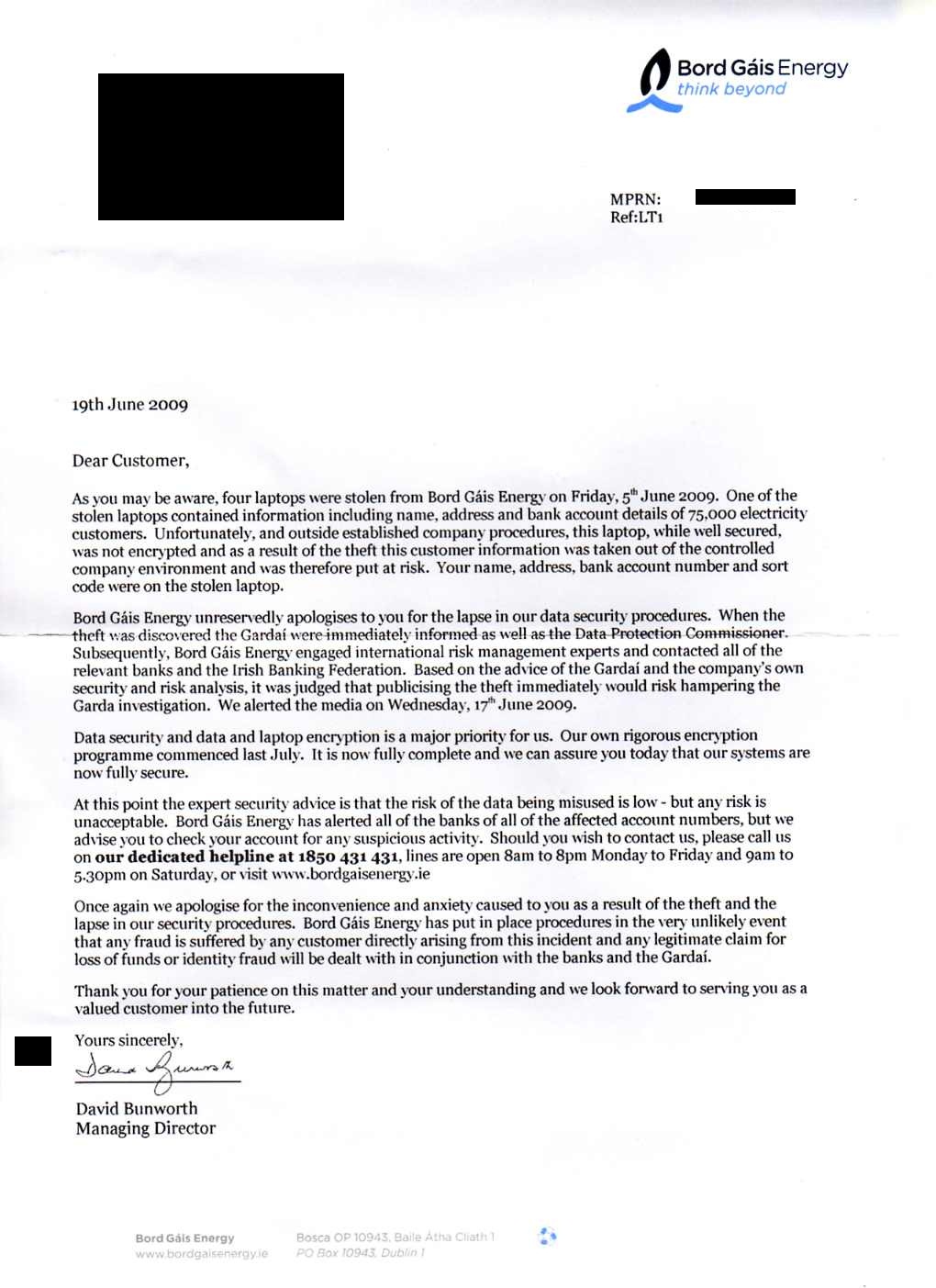
#
Project Voldemort : ASL-licensed DHT from LinkedIn
dht apache hashtable voldemort linkedin java storage networking cloud scalability
Twitter leaked visitor usernames to third-party sites via Google Analytics : excellent research by Des Traynor. oops! the hole has since been patched
twitter privacy analytics tracking google des-traynor exploits vulnerabilities json javascript security
How to Brew - By John Palmer : book on home brewing, recommended by Glynn Foster
How to sync Google Calendar with KOrganizer : using GCalDaemon -- this works very nicely. it'd be nicer if it was built into KOrganizer, but hey
gcaldaemon google google-calendar scheduling calendar kde korganizer howto apps pim
Interview with an Adware Author : great interview. 'In your professional opinion, how can people avoid adware?' 'Um, run UNIX.'
adware windows blackhat bho malware viruses spyware vista xp
#
Xarvester, the new Srizbi? : the evidence looks pretty convincing
Supervisor : 'a client/server system that allows its users to monitor and control a number of processes on UNIX-like operating systems.' looks quite sensible, BSD licensed, Python, works on Linux, Solaris, OSX and FreeBSD (via Conall)
via:conall supervisor daemon monitoring daemontools sysadmin management deployment service init unix linux
#
A coworker today, returning from a couple of weeks holiday, bemoaned the quantities of spam he had to wade through. I mentioned a hack I often used in this situation, which was to discard the spam and download the 2 weeks of supposed-nonspam as a huge mbox, and rescan it all with spamassassin -- since the intervening 2 weeks gave us plenty of time for the URLs to be blacklisted by URIBLs and IPs to be listed by DNSBLs, this generally results in better spamfilter accuracy, at least in terms of reducing false negatives (the "missed spam"). In other words, it gets rid of most of the remaining spam nicely.
Chatting about this, it occurred to us that it'd be easy enough to generalize this hack into something more widely useful by hooking up the Mail::IMAPClient CPAN module with Mail::SpamAssassin, and in fact, it'd be pretty likely that someone else would already have done so.
Sure enough, a search threw up this node on perlmonks.org, containing a script which did pretty much all that. Here's a minor freshening: download
reassassinate - run SpamAssassin on an IMAP mailbox, then reupload
Usage: ./reassassinate --user jmason --host mail.example.com --inbox INBOX --junkfolder INBOX.crap
Runs SpamAssassin over all mail messages in an IMAP mailbox, skipping ones it's processed before. It then reuploads the rewritten messages to two locations depending on whether they are spam or not; nonspam messages are simply re-saved to the original mailbox, spam messages are sent to the mailbox specified in "--junkfolder".
This is especially handy if some time passed since the mails were originally delivered, allowing more of the message contents of spam mails to be blacklisted by third-party DNSBLs and URIBLs in the meantime.
Prerequisites:
- Mail::IMAPClient
- Mail::SpamAssassin
#
Neil Fraser: Writing: Differential Synchronization : Impressive N-way sync algorithm for syncing text. 'Differential synchronization offers scalability, fault-tolerance, and responsive collaborative editing across an unreliable network.'
research networking sync diff patch synchronization neil-fraser google development editing collaboration algorithms differential-synchronization
#
McSweeney's Internet Tendency: The Elements of Spam : '(Excerpts courtesy of William Strunk Jr., E.B. White, and Generouss Q. Factotum.)'
funny spam writing parody english mcsweeneys usage grammar spelling humour
A Warning About the Real Cost of Microformats : Gordon Luk: 'I'm done with microformats. From now on, i'm either building separate developer tools and relationship, or i'm not'
AWS Console : a nice AJAXy web-based GUI for EC2. awesome! Even a commandline weenie like myself can see how useful this is
#
Map/Reduce and Queues for MySQL using Gearman : A talk by Eric Day and Brian Aker at the upcoming MySQL Conference in April: '[Gearman] development is now active again with an optimized rewrite in C, along with features such as persistent message queues, queue replication, improved statistics, and advanced job monitoring. For MySQL, there is also a new user defined function to run Gearman jobs, as well as the possibility to write your own aggregate UDFs using Gearman. This gives you the ability to run functions in separate processes, separate servers, and in other languages. The Gearman framework gives you a robust interface to also run these functions reliably in the "cloud". This session will introduce these concepts and give examples of sample applications.' Persistent queues (at last)? Gearman integration directly in the DB? excellent!
gearman queueing mysql databases brian-aker mapreduce sql conferences talks papers
#
Twitter hack actually due to dictionary attack : see also http://blog.wired.com/27bstroke6/2009/01/professed-twitt.html . So, some more Twitter antipatterns: 1. user account with admin privileges, instead of role account; 2. admin account without two-factor auth; 3. no rate limits or other dictionary-attack defenses
twitter security webdev lessons antipatterns dictionary-attack accounts authorization authentication role-accounts two-factor-authentication rate-limiting via:simonw
Google's Browser Security Handbook : by lcamtuf, a GOOG employee these days. comprehensive. 'provide[s] web application developers, browser engineers, and information security researchers with a one-stop reference to key security properties of contemporary web browsers'
security web google http browsers javascript html reference lcamtuf via:aecolley webdev
Wiggle.co.uk : another option for online bike sales, tipped by Boards.ie denizens. no free shipping here though
how to install from .ISO in vmware server 2.0 : omg this is utterly idiotic. not impressed
BikeToWork - boards.ie Wiki : a good collection of additional factoids about the govt bike-to-work scheme
Rechargeable Battery Review AAA NiMH : same again, for AAA batteries this time (via IRR)
aaa batteries rechargeable via:irregulars recharging nimh electronics reviews testing
The Great Battery Shootout : rechargeable batteries put to the test (a few years ago at least). quick summary: Panasonic shite, Energizer 2300 good (via IRR)
via:irregulars batteries recharging rechargeable aaa aa electronics testing reviews nimh charger power
The cycle to work scheme : Green Party site on the new Cycle-to-Work scheme, whereby the govt will provide a tax exemption if your employer buys you a bike up to EUR1000 in value
#
Closing the 'Collapse Gap': the USSR was better prepared for collapse than the US : I came across this a while back and have been looking for it again for a while. Good document on what happened in the former USSR after its society collapsed -- pretty funny too. A bit heavy-handed in its criticism of the US though (via Bruce Sterling)
politics history usa government society russia ussr economy collapse sustainability orlov futurism america world
Moviestar.ie now fulfilled by Screenclick.com : Irish DVDs-by-mail market consolidation
screenclick moviestar.ie dvd film tv ireland business mergers
LINX Public Affairs - Cinema ratings and web sites : Good commentary on the absurdity of the UK govt's attempts to impose age-rating certs on websites. 'From a regulatory point of view, at least part of the Internet is more like a pub, football crowd or playground than it is like a TV programme.'
linx ratings censorship uk politics filtering web andy-burnham free-speech
#
shouting at a disk can increase latency : funny anecdote. bookmarked mainly because of the nice SmokePing-like chart they're using to chart I/O latency stats... wonder if I can apply similar dataviz for spamassassin's rule-QA...
rule-qa spamassassin dataviz infoviz latency smokeping graphs charts storage audio shouting disks solaris funny
#
Want to rent a house in Stoneybatter? : I'm letting out our house in the 'batter; 2 bedrooms, 15 mins from town, cosy, great neighbourhood. A little bit of heaven in Dublin 7
stoneybatter ads housing rental dublin-7 d7 kirwan-st neighbourhood daft
#
Want to rent a house in Stoneybatter? : I'm letting out our house in the 'batter; 2 bedrooms, 15 mins from town, cosy, great neighbourhood. A little bit of heaven in Dublin 7
stoneybatter ads housing rental dublin-7 d7 kirwan-st neighbourhood daft
#
The Ultimate Commodore 64 Talk @25C3 : in-depth exploration of the C=64, right down to the I/O bus, in a 64-minute presentation
hardware c=64 commodore-64 retrocomputing programming talks assembly 6502 6510 commodore via:vvatsa
Mozilla bug finds MITM attack in the wild : annoying Firefox "blah.foo.org uses an invalid security certificate" warnings cause user to open a bug at the Moz bugzilla, whereupon it is discovered that they are being haxx0red
mitm security firefox mozilla usability pki ssl man-in-the-middle